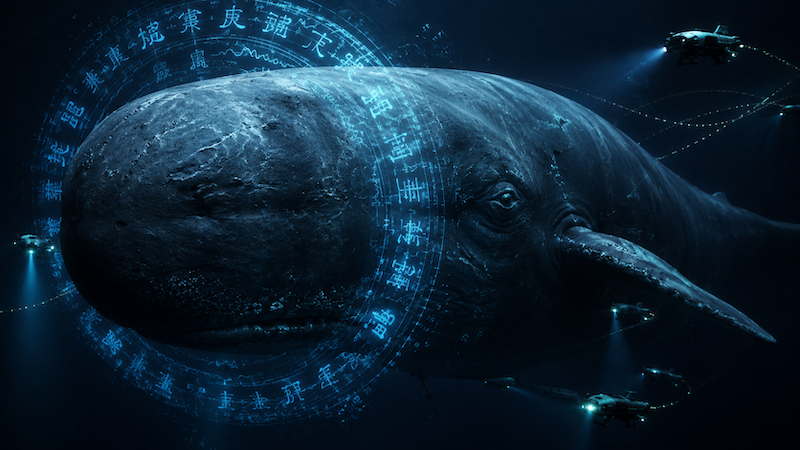
AI Speaks Sperm Whale

Posted May 25, 2026
Chris Campbell
For decades we aimed our best telescopes at the sky, hunting an intelligent signal.
The project had a name—SETI.
Billions of dollars spent on a single assumption: that intelligence worth hearing was somewhere else.
Out there. Somewhere. Far away.
Meanwhile, the real alien signal was 3,000 feet underwater the whole time.
Sperm Whales Speak
Sperm whales talk in codas—short, patterned bursts of clicks.
A project called CETI—Cetacean Translation Initiative—fed roughly 9,000 of these coda patterns into machine learning models.
Pretty soon, a loose structure fell out. A phonetic alphabet. A combinatorial system—a small set of building blocks the whales recombine into a near-infinite range of messages.
Then vowels emerged. Then tonal patterns researchers compared directly to Mandarin, where a single syllable carries four different meanings depending on pitch.
Why does that matter?
Because for seventy years we had the recordings and heard only noise. The clicks didn't change. We finally built something that could hear the structure that was always there.
To be sure, CETI found the alphabet. Not the dictionary.
Nobody knows what the whales are saying yet.
But that gap—alphabet versus dictionary—tells us a lot about where AI is headed.
Forget the Whales (For Now)
The whales are a benchmark.
What happened is this—a model built to predict the next word in a human sentence got pointed at a signal no human has ever spoken, and found grammar in it.
The architecture didn't care it was whales. It would not have cared if it were anything else.
So ask the question…
What else is a structured signal humans can't read?
Protein sequences. Genomes. Undiscovered materials. Seismic data.
DeepMind's AlphaFold already did proteins—and collected a Nobel for it.
Google's DolphinGemma is doing dolphins.
The template is set: find a domain with real structure and lousy human tools, point a transformer at it, wait.
Where The Money Goes
For three years, the AI trade has been one thing: AI that talks to people. Chatbots. Copilots. A crowded room.
The whale result points somewhere else. This is AI that reads the structure of the physical world—biology, chemistry, materials. Anything with a hidden pattern is now fair game.
That shift changes what matters.
The obvious takeaway is that compute demand will keep growing.
Every new field that gets its own AI model means more chips running, around the clock.
Biology gets a model. Materials get one. Defense gets several it won't talk about.
The companies selling the hardware—chips, memory, the wiring between them—get paid every time someone tries, win or lose.
But the moonshot tier exists, and yes, it's where the ten-baggers come from.
Here’s what I’m doing this weekend on that front…
- Putting the AI-biotech catalyst dates in my calendar. FDA decisions, trial readouts, breakthrough-device designations. These are dated and public. To position before the date, not after the pop.
- Building a one-page "data owner" list and waiting. Names sitting on proprietary datasets—medical imaging, seismic, insurance claims, genomics. I’m not buying yet. I’m waiting for the first AI-lab licensing deal in each category. That deal is the first trigger.
And lastly…
- Finding the solution to the Tower of Babel problem. If AI can decode any signal, it can also generate convincing fake signal—fake whale codas, fake biological data, fake "decoded" anything. The counter-industry is signal authentication for non-human data. Weird now. Inevitable later.