
Carbon: We Owe You an Apology

Posted March 05, 2026
Chris Campbell
Sometimes the universe hides its best tricks in plain sight.
And carbon—without any doubt—is the universe's favorite trick.
Six carbon atoms. Locked in a hexagon. Repeat.
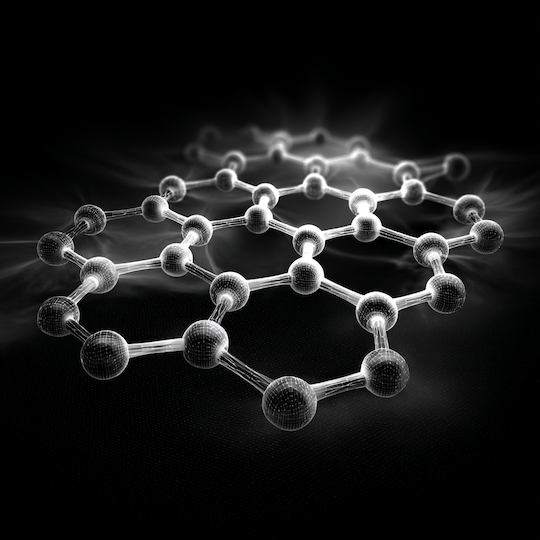
This shape is everywhere.
In the smear of soot on a barbecue grill. In the shock wave of a supernova. In the nucleobases of your DNA—adenine, guanine, cytosine, thymine—every single one built around the same hexagonal carbon ring.
The universe didn't stumble into this shape.
It kept returning to it.
And, here’s the thing…
This shape—ancient, cosmic, impossibly simple—is about to become the most important structure in the history of materials science.
Not because it wasn’t important before. But because we're only now learning to use it.
The Universe's Favorite Molecules
When stars die, they explode.
Those explosions forge carbon into strange complex shapes and scatter them across space. They hitch rides on meteorites. They settle into ancient rock.
They ended up on Earth.
This image below shows three ways carbon has formed for billions of years. Same atom, different shape—and the shape changes everything.
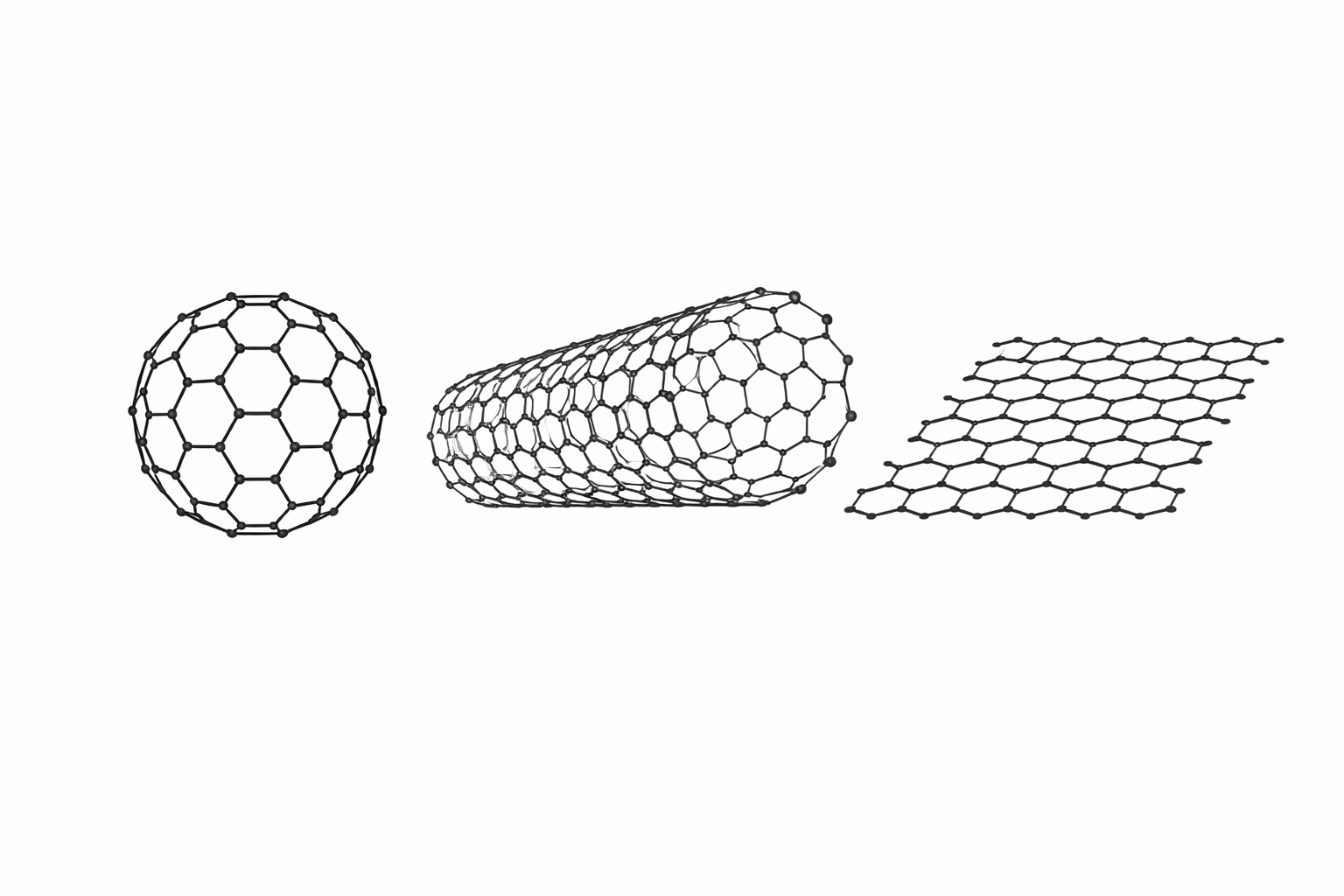
The first is a flat sheet (graphene). The second is that sheet rolled into a tube (carbon nanotubes, or CNTs). And the third is that tube closed into a sphere (carbon 60, or C60).
And, yes, they’re tiny.
C60 is about 1 nanometer in diameter. A human hair is roughly 80,000 nanometers wide. You could line up 80,000 of them across a single hair.
Meanwhile, C60 is strong and stable enough to survive a supernova. Its hollow cage can carry drugs to precise locations in the body, releasing them only where needed. It also can act as a free radical sponge—neutralizing oxidative damage faster than any antioxidant we've synthesized.
Graphene is one atom thick. There is nothing thinner that qualifies as a solid material.
It conducts electrons faster than any metal we've found. It's 200 times stronger than steel, yet flexible enough to fold. It's transparent. No material in history has combined these properties. None.
Carbon nanotubes are 1–2 nanometers wide—though they can grow to millimeters long. Imagine a needle that’s a million times longer than it is wide.
They are stronger than graphene by some measures. They conduct heat better than diamond. They bend without breaking yet are stiffer than any known fiber. And depending purely on the angle of the roll, the same tube is either a metal or a semiconductor. No doping, no modification. Just geometry. No other material works that way. None.
These aren't incremental improvements on existing materials. They're a different category of matter.
And the most important part…
Life Recognizes Them
When researchers implant electrodes into brain tissue—platinum, silicon, tungsten—the immune system attacks. Scar tissue forms. The signal degrades.
The brain treats the metal as an invader.
When they implant graphene, nothing happens. The inflammatory cascade that destroys every other foreign material simply doesn't activate. The neurons grow toward it. The signal holds.
The brain isn’t just “tolerant” of graphene like it is with some exotic materials like titanium. The brain recognizes it.
The reason goes deeper than just “carbon likes carbon.”
And it has to do with what I call the "God Molecule Hypothesis."
The core claim is simple: these nanocarbon structures once served as the scaffolding for all basic components of life—some of which likely formed out in space, long before Earth existed.
Life didn't build itself from scratch. It assembled onto these superstable carbon structures. DNA, enzymes, proteins—they all use the geometry (and reveal the same properties) of nanocarbons.
So, in the case of the graphene implants, the body doesn’t just recognize the carbon.
It recognizes its own granddaddy geometry.
Carbon Age Rising
Every civilization is defined by its dominant material.
Stone. Bronze. Iron. Steel. Silicon.
Each transition looked incremental from the inside.
Then suddenly it didn't. Iron didn't improve bronze-age civilization—it replaced it. The sword, the plow, the bridge.
Everything rebuilt from a better material up.
We're at that threshold again.
Carbon is stronger than steel, lighter than aluminum, more conductive than copper, more biocompatible than anything we've implanted in the human body.
It can be a semiconductor or a metal depending on geometry alone.
It can carry drugs, store energy, filter water, replace silicon, interface directly with biology.
And we're only now learning to manufacture it at scale.
The carbon fiber market hit $5.75 billion in 2024. It's heading to $10.68 billion by 2030. That's carbon fiber—the crude, early version.
Graphene, carbon nanotubes, and C60 are the refined forms. Their markets are just beginning.
AI chips. Quantum computing. Drug delivery. Energy storage. Next-generation materials.
Every one of these fields is running into the same wall—the limits of what silicon, metal, and conventional chemistry can do. And every one of them will find the same answer on the other side of that wall.
Carbon.
The transition from silicon to carbon will be the biggest structural change to civilization since electricity.
First, it’ll look like a better battery, a faster chip, a car so strong it can withstand a meteor strike. Then one day we’ll look up and the foundation will have changed.
Life figured this out four billion years ago.
Industry is just catching up.