Confessions of a Cereal King
Posted October 28, 2026
James Altucher
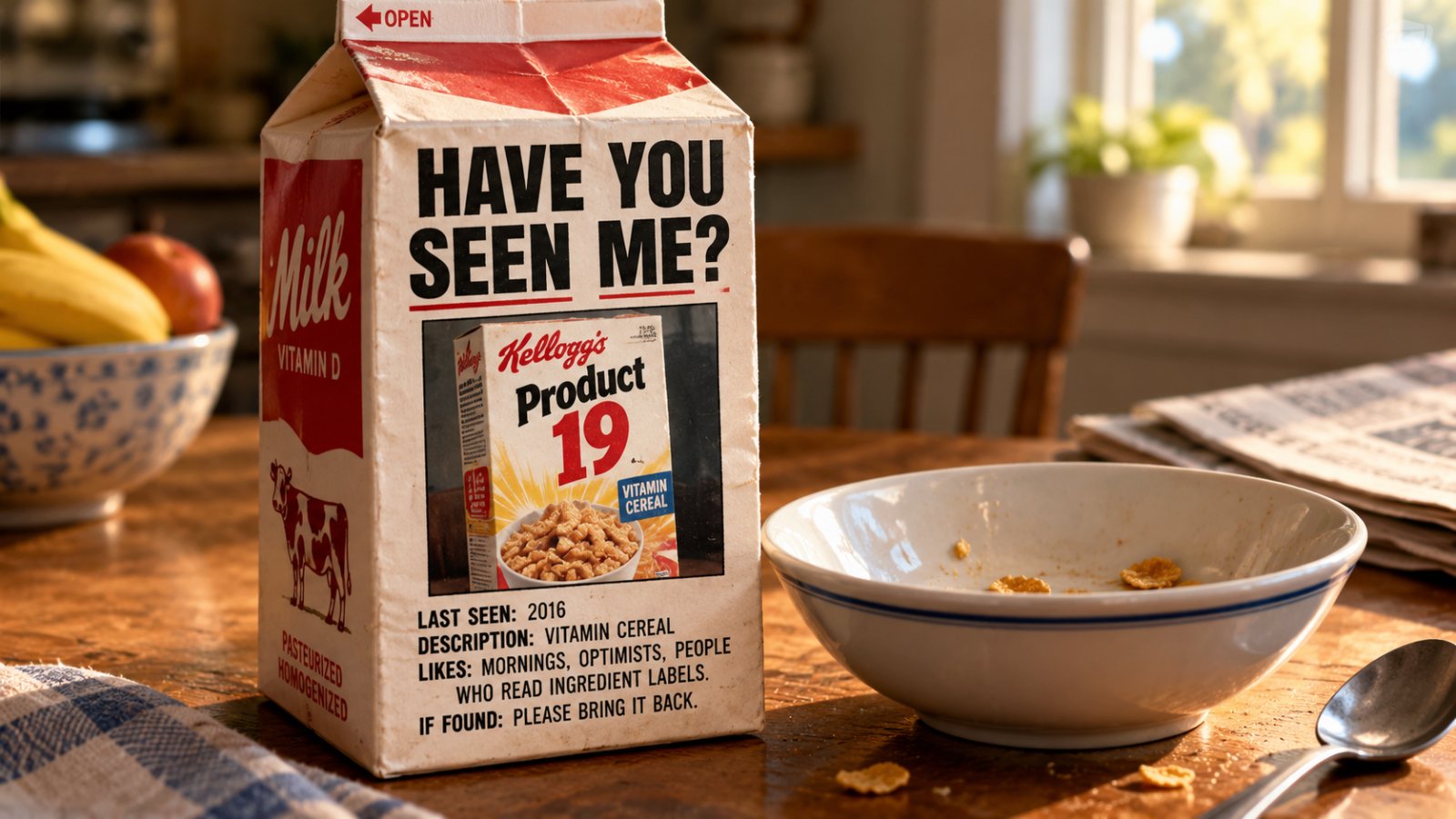
For ten years I’ve wanted to know who killed Product 19.
You probably never ate it. Most didn’t. I might have been the only one.
Product 19 was Kellogg’s “vitamin cereal.” Gone since 2016. No explanation. No apology. I looked.
Then the former CEO of Kellogg agreed to come on my podcast. I asked him directly.
He said it happened after he left.
I'm still upset. It was the one thing Carlos Gutierrez couldn't give me.
From Cuba to Kellogg to the Cabinet
Carlos left Cuba as a kid after his father tempted fate with Che Guevara. The family lost everything.
He started in sales at Kellogg and climbed all the way to CEO. Then George W. Bush made him Secretary of Commerce. Then, at 65, a doctor told him he had ADHD.
He wrote a book about all of it called Sheer Will: Learning to Lead When There is No Path. I loved it.
Here's what I learned from Carlos.
1. Speed is a luxury. And you have it.
I asked Carlos if Washington taught him anything about buying and selling companies.
He said the two worlds barely compare. At Kellogg, he made the call. Sometimes the board had to approve it. Sometimes. Then he ran with it.
In Washington, almost nothing gets decided without going through someone else who then has to go through someone else.
Speed is a luxury of the private sector. (That means you too.)
This is useful to know for investors. I use the same rule when I hunt for buyout opportunities. Find the buyer who doesn’t need permission.
Right now, that’s Elon Musk. He controls more than 80% of SpaceX’s votes. He’s the CEO and the chairman, and he picks the board. And SpaceX just raised $75 billion in the biggest IPO in history. That’s where I’m watching.
2. Refusing to be average starts with proving someone wrong.
I asked him what "relentless refusal to be average" meant in his book. He said it's what's left over from being the disorganized ADHD kid everyone expected to fail. He wanted to prove them wrong. He learned to welcome struggle. It’s the price you pay.
He added that America is the only country where calling someone ambitious counts as a compliment.
3. The weakness was hiding a strength.
In hindsight, the ADHD diagnosis explained a lot about his career. He would drop everything and hyperfocus on one presentation for three weeks. That helped him more than any weakness hurt him. His one wish: that someone had told him about the upside sooner.
Most of us spend years apologizing for the thing that makes us great.
4. Be bad at a lot of things.
At community college he got Ds in every class except one. Public speaking. Later he found financial management. Those two skills carried him to the top. I asked if it's a numbers game. He said yes. You have to be wrong about many things to find the two you're good at. He still gets it wrong today. That’s OK.
5. The first year as boss is supposed to hurt.
His biggest early mistake as CEO was hiring outsiders. He wanted to show Kellogg that fresh blood adds value. They didn't fit. He tells new CEOs to expect a rough first 12 months.
In that first year, he made decisions based on how he thought a CEO was supposed to act. After a year, he stopped. He went with his gut, backed by 30 years at the company. That changed everything.
6. Make the hard call or hand over the job.
His father told him: if you can't make the tough decisions, someone else should have your job. When Carlos closed Kellogg’s Battle Creek plant, he kept that line in his head. Explain the decision. Stay firm on it.
Over the next five years, Kellogg’s sales grew 43%. Its stock nearly doubled.
7. Walk in with one ask.
China once wanted intellectual property left off the agenda for an annual meeting. So Carlos gave a public speech announcing he was canceling the trip. It worked.
That’s the thing about China. Most meetings were a grind. America showed up with 20 problems from American companies. China showed up with one or two asks, like lifting export controls. Then China tied everything to those. No progress on their list, no progress on ours.
A short list is leverage.
Also the minute your plane lands, China treats you like the most important person on Earth. Then it’s harder to be tough on such gracious hosts. It works.
8. Politics runs on perception.
Everyone in Washington believed the economy was "fundamentally sound" in March 2008. Back then, he said, the numbers backed it up. Then the subprime collapse hit. His summary of Washington: "Politics is the art of perception. Business is the art of results."
9. AI helps your competitors too.
I asked if AI makes starting a business less risky. He said AI helps everyone, so you still have to beat everyone. Starting a company will always be hard.
10. Stay put.
His advice to a 25-year-old: find a company you love and give it five to ten years. Most quit right before the payoff.
Carlos left the cabinet at 55. He said the years after were his hardest. He chased things that sounded great and didn't have the same hunger.
I'm 58. I'm still trying to figure out what I want to do.
Maybe that's the real lesson. Nobody figures it out. The good ones just keep asking. (And the really good ones bring back Product 19.)