Elon's Missing Metal

Posted May 26, 2026
Matt Badiali
Elon’s been fairly clear about the master plan: a million people on Mars. A thousand Starships per launch window. A self-sustaining city on another planet.
Here's something he talks about less:
He can't pull it off—or build anything that flies, drives fast, or walks on two legs—without a metal North America no longer produces.
Not "produces less of." Produces none.
The metal is magnesium. And he needs a lot of it.
Stat.
NASA is already studying how to mine it off the Martian surface and burn it as rocket fuel to get astronauts home. Every modern spacecraft uses it somewhere—satellite housings, gearboxes, structural components where every gram matters. The lighter the rocket, the further it goes on the same fuel.
And the thing…
The only North American producer just went bankrupt.
The reason I know this is our Paradigm colleague Matt Badiali.
Matt’s a geologist.
He started out pulling soil and water samples in the roughest parts of Miami as an environmental geologist. Then came the drill rigs. Then the mine sites—Papua New Guinea, the Yukon, Iraq, the Mexican desert, British Columbia.
He studied earth sciences at Penn State, took a master's in geology at Florida Atlantic. He's presented research to ExxonMobil and Anadarko. He's shared stages with T. Boone Pickens and Ross Beaty.
Today, he's one of Paradigm's sharpest minds on critical minerals… and he runs a publicly traded copper company on the side.
So when North America loses the ability to produce a strategic metal—as just happened with magnesium—he's the guy we want on the case.
Check out his full write-up—and the best way to get exposure—below.
Read on.
Elon's Missing Metal
In 2025, the only primary magnesium producer in North America quietly went bankrupt.
U.S. Magnesium was a fixture on the southwest shore of the Great Salt Lake in Utah. It extracted magnesium from the lake’s brine since 1972. However, a legacy of environmental issues, catastrophic equipment failure, and cheap Chinese imports finally killed the company.
The state took control of the plant, which is now a massive super-fund site.
The U.S. consumes as much as 200,000 metric tons of magnesium per year. Some of that comes from recycling. But most of it gets imported. Analysts forecast that consumption will grow by 5% per year through 2030.
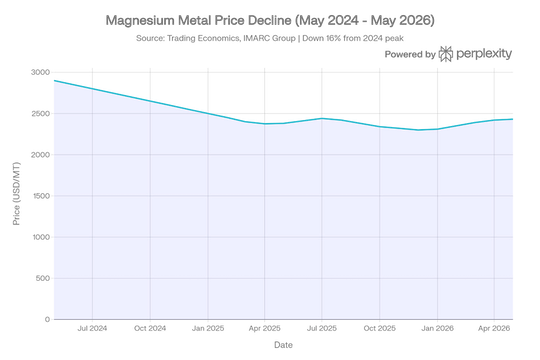
Magnesium is critical for making rockets and cars lighter. The metal is 75% lighter than steel and 33% lighter than aluminum. It’s the lightest structural metal known. Lightening the weight of a rocket makes them perform better and use less fuel.
In vehicles, 15% weight reduction by replacing some of the steel or aluminum with magnesium led to as much as 12% fuel savings. That’s without sacrificing anything in the design of the vehicle.
High end car designers at Porsche, Audi, Mercedes, and Jaguar use magnesium for critical components because it improves handling and turning. Plus, the metal reduces vibrations, which reduces road noise.
Magnesium alloys can withstand extreme temperatures, which makes it critical for intercontinental ballistic missiles like the Titan, Atlas, and Agena rockets. Aluminum-magnesium alloys also resist solar radiation damage. That allows the spacecraft to stay in space longer.
And NASA plans to use a magnesium rocket system for the Martian program. The engineers plan to mine magnesium from the Martian surface to replenish the fuel used on the trip. That would allow the rocket engine to be smaller and lighter, with the same performance.
To meet the magnesium needs for these emerging technologies, the U.S. (and Canada…and Mexico) must import the metal.
The U.S. government awarded a small private startup called Magrathea Metals a $19.6 million grant in 2024. The company plans to develop magnesium production from seawater. But right now, there are no investable companies that operate in the U.S.
For now, the best way to get exposure to magnesium production is through giant mining companies like Albemarle (NYSE: ALB). But we need this metal for space travel, so we’ll be watching for a domestic producer to emerge.