
FLYTRAP: The AI Trading Experiment

Posted September 17, 2026
Chris Campbell
Last week it lost me $300.
The week before that, $400.
Fortunately, they’re all pretend dollars.
I call it FLYTRAP
It’s an experimental AI trading system. It takes its name from the venus flytrap—the patient predator that waits. He who does not chase.
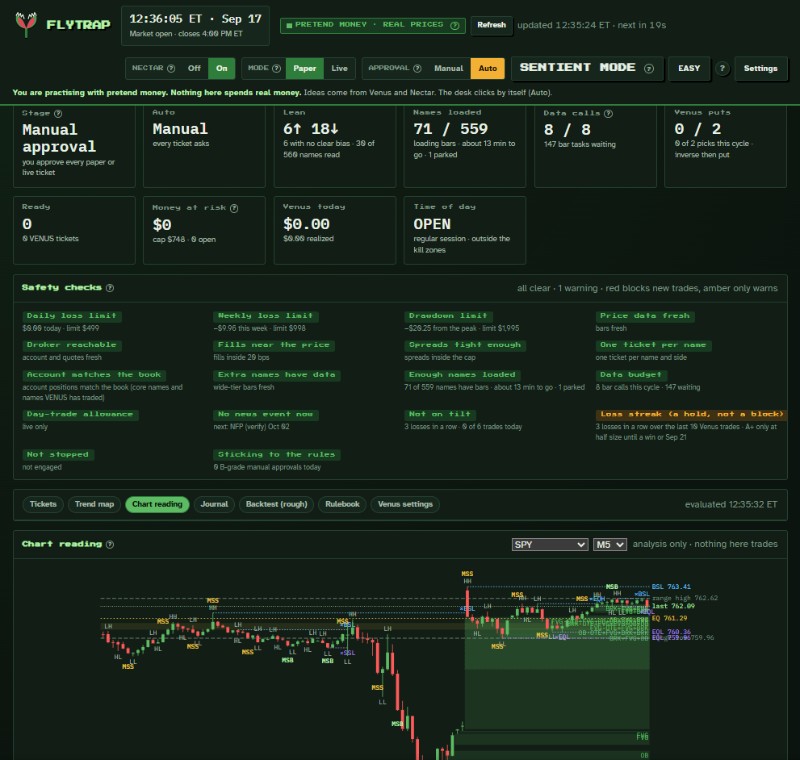
I've been building it on weekends, throwing AI at the one problem that humbles everyone who touches it: the markets.
It sits on my computer. It stares at the stock market all day. And it has four brains.
- NECTAR watches about 150 stocks. Grades every one on classic technicals—trend, momentum, volume, position in range—with a contrarian tilt. It always waits for the turnaround. Buys the ones the crowd is quietly abandoning that still have their fundamentals intact. Sells the ones everyone's cheering while the tape is quietly rolling over.
- VENUS is the brain with the Michael Huddleston framework: order blocks, fair value gaps, liquidity sweeps, silver-bullet setups in the 10 AM window. It reads the market the way institutions do: as a map of where the stops are buried.
- SENTIENT is the boss. Manages a budget. Picks which of Nectar's ideas and Venus's ideas get real money. The CFO of my little Skynet.
- FLYBRAIN is the memory. It uses a wiring diagram of an actual fruit fly's brain—the one Janelia Research Institute published—to remember every trade the desk has ever done. When a new setup shows up, FLYBRAIN says: "Hey, this shape reminds me of that time we won on XYZ." Or: "Hey, this shape reminds me of the time we lost our shirt on TVX."
Finally, it has a "market compass."
It reads the whole tape—S&P, VIX, bond yields, the dollar, oil, sector rotation, news mood, time of day.
Because a killer setup on NVDA in a bull tape is not the same trade as a killer setup on NVDA when yields are ripping.
The whole thing runs quietly, all day. Close the browser, it keeps going. Open the browser, one number tells me how it’s doing.
There’s No Genius Here
I built this with Claude Code. If you haven’t used Claude Code, it's an AI that argues with you until it finally does what you want it to do.
I type "the flybrain is showing an error.”
It says it is working fine. I say you’re wrong. It says OK you’re right. It goes, fixes it, ships it, restarts the trader, updates its own memory of what changed.
Version 1 was garbage.
Version 5 was somehow worse.
Version 12 lost money faster.
Around version 25 I started making it learn from its mistakes.
I’m on version 30 and I’m seeing glints. Of what, I’m not sure. But glints.
That's it. That's the entire process.
There’s no genius here.
Just: "this is broken, fix it," ninety times in a row.
AI is a Drill
Everyone thinks AI is a printer. It's a drill.
A drill is faster than a hammer. Great. It also lets you drill holes in your foot much faster than a hammer ever could. I've drilled a lot of holes in my foot.
"I'll just have ChatGPT build me a hedge fund." People say this out loud. With confidence. I did too once.
Nobody says "I'll just open a restaurant." Because everyone knows restaurants eat you alive. AI products have the same failure rate. Only one gets hype.
AI is fast. Taste, judgment, and tacit knowledge are slow.
Which is why I'm MORE bullish on AI. The moat isn't the model—everyone has that. And it isn't grit either, though grit is the price of admission.
That means the AI trade isn't "buy the companies that use AI." Every company uses AI. That's like saying "buy the companies that use electricity" in 1920. Useless.
It’s what they do—and keep doing—with the AI that matters. And that’s the part that hasn’t changed.
Version 1 of Airbnb was three air mattresses.
Version 50 of FLYTRAP is down sixty-nine dollars in the past 30 minutes.
Version 200, we'll see.
If you’re building ambitious things with AI: there’s no simple trick. There's a bad first version, a somehow worst 10th version, and the stubbornness to build the 100th. That's it. That's the lesson.
Maybe FLYTRAP gets there. But that's not the interesting part. The interesting part right now is the building.