
Forget the Flying Car

Posted October 16, 2026
Chris Campbell
Elon Musk finally delivered the flying car.
Sort of.
On Thursday, at a SpaceX test site in McGregor, Texas, a Tesla Roadster drove up a curved ramp, hung upside down, fired ten thrusters, barrel-rolled and landed.
Then, for good measure, it hopped over a Cybertruck.
Nobody was inside.
Musk said the car drove itself "to make sure we don't kill anyone." The FAA fenced off the sky. The flying version carries a label only a lawyer could love: "not approved for public road use."
The fuel? Compressed air. Six hundred liters of it. Just enough for a few seconds of glory.
The Roadster itself was first promised for 2020. Production is now “planned for 2028.” No price. But of course… you can reserve one.
The flying version? Invite only. And you can't drive it on the road. Even Musk doubts it’ll do much for Tesla’s revenue.
Hall Saw This Coming
In 2018, a nanotech researcher named J. Storrs Hall wrote a book called Where Is My Flying Car?
Silicon Valley's progress crowd treats it as scripture.
Peter Thiel built a slogan around the same complaint: "We wanted flying cars, instead we got 140 characters." Musk told Joe Rogan he built the flying Roadster partly because Thiel wanted one.
Hall's argument is simple: Flying cars worked. Prototypes flew in the 1930s and '50s. Then something broke. For two centuries, the energy America used grew about 7% a year. Hall calls it the Henry Adams curve.
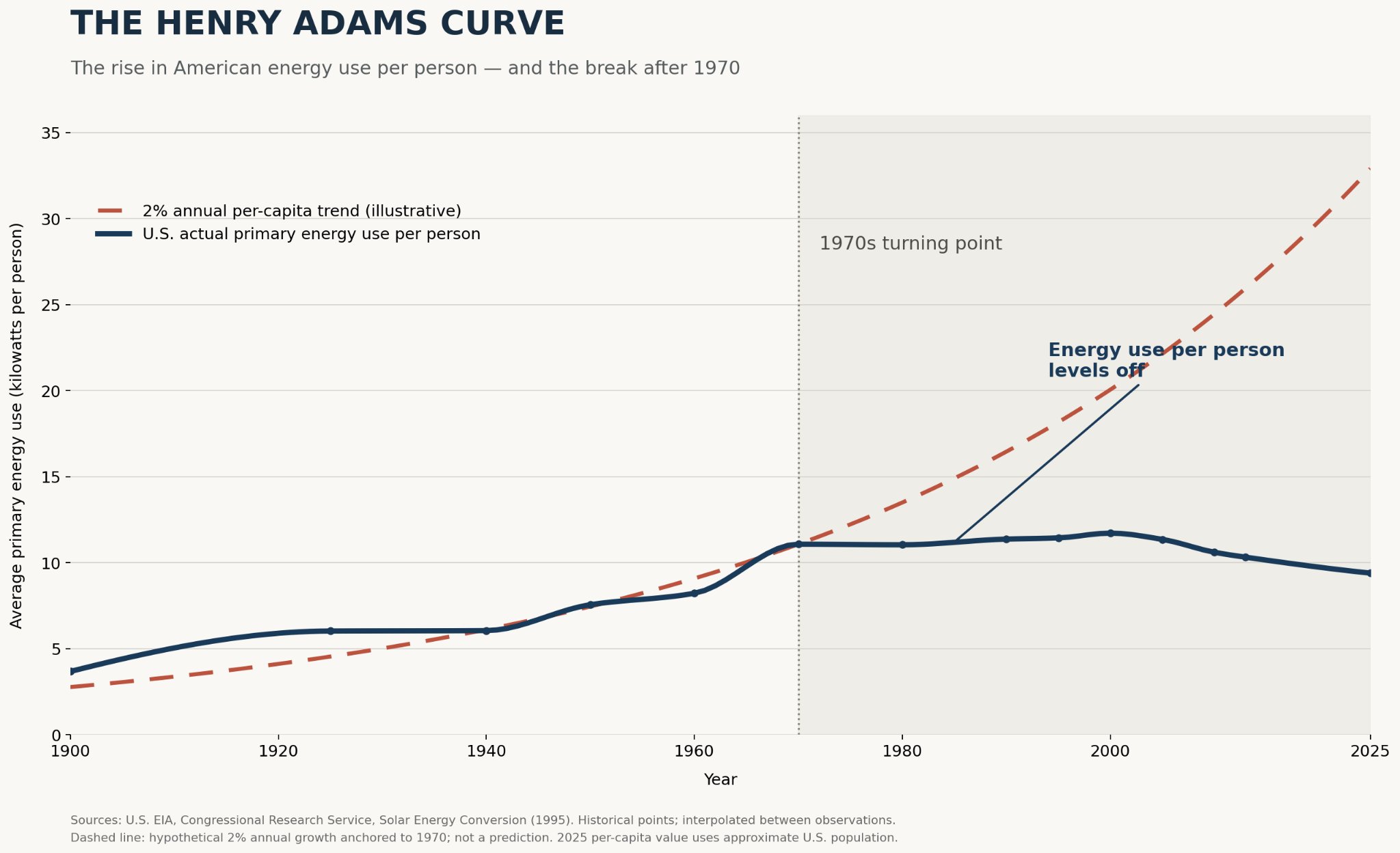
Around 1970, it went flat.
If that date rings a bell, you’ve probably seen the website WTF Happened in 1971? It’s nothing but charts. Wages split from productivity. Housing outruns paychecks. Debt goes vertical. Every line bends at the same spot.
The WTF site blames money. Nixon closed the gold window in August 1971. Hall blames energy.
But maybe it’s one crime.
American oil production peaked in 1970. The dollar went soft in 1971. Inflation followed. By 1980, interest rates were near 20%. A nuclear plant is a ten-year loan on a forty-year machine, and at those rates nobody builds one.
More than 100 reactor orders were cancelled. Private aviation drowned in liability and paperwork. A rich, comfortable culture decided burning energy was a vice.
Soft money, soft energy. And the reverse. A country that can’t grow its power supply can always grow its money supply. We picked the printing press.
The Curve is Twitching
As Hall argued, a flying car only needs two things.
- Lots of cheap energy.
- And permission to use it.
Thursday’s Roadster had neither. A tank of air, flown empty, on private land, under federal airspace restrictions. Both of Hall’s walls, hit face first. Upside down.
But here's what didn't get lost in the barrel roll. The Henry Adams curve is twitching.
American electricity demand hit a record in 2025. The EIA expects new records in 2026 and 2027. GE Vernova has 116 gigawatts of gas turbines under contract or reserved, and it's booking slots for 2031.
Washington just lent $4.4 billion to restart three shut-down nuclear reactors. A big transformer now takes over two years to arrive.
The driver is AI. But the trillion-dollar question: will it last?
2001, Again?
Between 1996 and 2000, telecoms spent over half a trillion dollars, mostly borrowed, laying fiber. Then the music stopped. Global Crossing went bankrupt in January 2002. Years later, most of that fiber still sat dark.
The builders lost everything. But the fiber stayed. Cheap. Waiting. It went on to carry YouTube, Netflix and the cloud.
A similar split is forming now. Data centers use about 5% of America’s electricity. But they drove half of last year’s growth in demand.
But compare shelf lives. A GPU is old in five years. A gas turbine runs for thirty. A restarted reactor runs for decades. And only about a fifth of GE Vernova’s turbine orders are tied to data centers. The rest go to ordinary utilities.
If a big AI bust comes, the GPU renters eat it. The power plants will stay. And the rest of us inherit the surplus.
Of course, timing matters. By 2030, data centers could be using up to 17% of America’s power. The later the bust, the more steel is already in the ground. And the bigger the inheritance.
So Where's My Flying Car?
Musk answered that one on Thursday. It's a remote-controlled stunt full of air.
Hall asked the deeper question decades early. Where'd all the power go?
That one is finally getting answered. Quietly. In turbine factories, reactor control rooms and transformer yards nobody films.
The permission wall is cracking, too.
In March, the NRC approved construction of TerraPower’s reactor in Wyoming. It’s the first permit for a new kind of commercial reactor in over forty years.
Washington, which spent decades strangling nuclear, is now lending billions to bring dead plants back. Hall’s walls were built by people. People can take them down.
The flying car comes later.
It always has.