
How to Win Big in Medieval Times

Posted December 23, 2025
Chris Campbell
End of years are times of reflection.
But if you reflect long and hard enough, you might end up in unexpected places…
The Middle Ages, for example.
Back then, they lived among ruins, deferred to institutions past their prime, and watched feral youth abandon the map entirely.
(Sound familiar?)
Today, let’s talk about why we’re more medieval than we realize….
What that actually implies….
And how to thrive when the future feels like a long, hard winter.
Are We in the Middle Ages?
People living back then never called themselves medieval.
They felt late. Late in history. Late in the world. Late in meaning.
The peak had already passed. Rome was gone. The giants were gone. Truth lived in inherited texts, but revised. Originality carried suspicion.
At the same time, they didn’t experience themselves as stagnant or stupid.
On the edges, they built cathedrals, universities, legal systems, clocks, accounting methods, and philosophical frameworks of enormous sophistication. Their sense of lateness coexisted with an intense effort to restructure their systems.
That mood feels familiar. The 2020s share it.
Not collapse—something quieter. Decay paired with upkeep. Institutions still standing. Authority still claimed. Legitimacy slowly thinning.
We live among monuments we sense cannot be rebuilt.
A single income buying a family home. National rail networks built for expansion, not nostalgia. A social contract that traded effort for ownership. Mid-century housing (my biggest beef).
They surround us like Roman aqueducts: visible, impressive, somehow impossible to recreate.
That feeling creates medieval thinking.
“Medieval” means in the middle. And in the middle, the future is not something you design or plan for…
It’s something you survive.
“Late-Stage” Feeling Is Not New
Medieval Europeans believed the world itself was aging.
Crops failed because the earth was tired. Political chaos signaled apocalypse. Decline became the default explanation for everything.
Modern language mirrors this almost exactly. “Late-stage capitalism.” “End of history.” “Everything is cooked.”
When people lose faith in forward motion, mass-culture shifts from creation to commentary.
Mainstream medieval scholars did not invent new philosophies. (And if they did, they were laughed at or kicked out of the room.) They wrote redundant revisions of Aristotle. They organized, compiled, footnoted.
It was a plague of pedants.
Meanwhile, practical reality—engineering, finance, navigation, timekeeping—saw incredible advances, but only outside elite philosophy, on the fringes.
Compare to today…
Endless remakes. Extended universes. Reaction content. Commentary stacked on commentary. A civilization talking to itself about things it already made and already said.
Meanwhile, outside of elite discourse, practical reality—coordination, computation, fabrication, settlement—is making mind-warping advances. Once more, reality is moving where meta-commentary has little jurisdiction.
That loop feels medieval because it is.
Another parallel…
The Savage Youths
Medieval society looked orderly on paper.
In practice, however, it produced some of the most feral youth cultures in history.
I’m serious. We should talk more about this.
University dropouts and half-trained clerics became wandering satirists, writing drinking songs that mocked church hypocrisy.
Unemployed apprentices formed street gangs, brawling with authorities and swearing fealty to one another in taverns.
Mercenaries tore their clothes into scandalous fashion statements and turned violence, scars, and color into identity.
Outlaws fled into the hinterlands and became folk heroes. Heretics rejected institutional mediation and tried to meet God directly.
After the plague, entire generations leaned into gallows humor, ecstatic suffering, or death-obsessed art as meaning collapsed.
None of it was random. It emerged when promised paths—faith, work, hierarchy—stopped delivering coherence.
When systems lose legitimacy, the youth don’t bother trying to argue with reason. They sing, riot, dress differently, mock power, chase transcendence, or disappear entirely.
Sounds like now.
Another thing…
A Visual World, Again
Most couldn’t read. Meaning arrived through images, ritual, performance.
Church walls taught theology. Town squares enforced morality. Symbols did the work that text once did.
Digital culture seems to recreate this structure.
Memes function the way illuminated marginalia once did. One image transmits an entire worldview without explanation. A doomer face carries more information than an entire chapter.
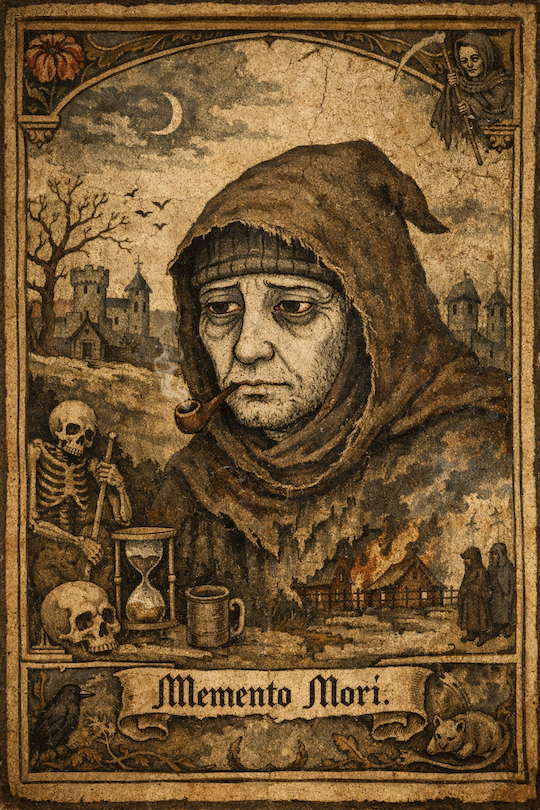
As visuals dominate, truth spreads the way it once did—socially. In oral societies, rumor outweighed record.
Communities, not institutions, decided what was real.
Social media mirrors that condition.
Print stabilized truth. Networks liquefied it. Visual media persuades without explaining.
Authority fractures along the same fault lines. Medieval life balanced overlapping loyalties—king, church, guild, city—none fully sovereign. Power worked as a Venn diagram.
Same-same.
Corporations enforce rules across borders. Platforms govern speech. Supranational bodies legislate without proximity to consequence. Private actors control satellites, logistics, and military infrastructure. Maps still show borders. Power hops around them.
It looks feudal because sovereignty is dissolving again.
And like before, this unstable gyre won’t hold forever.
Why This Phase Does Not Last
The Middle Ages ended because systems broke in ways that forced revaluation.
The Black Death shattered labor assumptions. Human effort became scarce. Wages rose. Feudal relations weakened. Power redistributed through necessity.
The Renaissance that followed began with a reorientation toward source material. Ad fontes. Back to originals rather than commentaries.
That impulse is already showing up.
Fatigue with reaction content. Suspicion of corporate LinkedIn language. Desire for rawness, locality, accent, error, context. A renewed respect for the human voice precisely because it fails.
AI accelerates this shift. Machines own polish. Humans reclaim imperfection.
AI floods the world with cheap output. Text. Images. Analysis. Content. It collapses the value of generic intellectual labor.
What becomes scarce is not output. It’s judgment. Taste. Risk. Soul.
Scarcity always reorganizes value.
The Renaissance also marked a turn away from subscription-like dependency toward ownership and craft. Guilds enforced quality. Reputation mattered. Products carried names.
A similar revaluation is happening.
People are quietly rejecting abundance without durability. Fast fashion fatigue. Subscription fatigue. Feature-bloated software. Disposable everything.
They want things, but not as many things. And they want those nice, fewer things to last.
Tools meant to be repaired, not replaced. Craft, provenance, and maker identity. Work that produces something you can point to afterward.
When effort no longer leads to ownership, optimism drains. That describes late medieval feudalism, but it also describes the 2010s—2020s platform economy: work produces engagement, data, or rent for others.
The good news…
When even small forms of ownership return, optimism follows. But it’ll show up quietly, the way all real shifts do.
(Getting ahead of it is getting ahead.)
The Point (Finally!)
The medieval period felt endless while people lived inside it. In retrospect, it compressed into a bridge between systems.
The 2020s occupy a similar position. Old legitimacy dissolving. New forms unproven. Confusion mistaken for terminal decline.
AI and crypto’s real potential is to help restore the missing middle step between effort, meaning, and matter.
For too long, people could work, even work hard, and still watch the results dissolve into rent, fees, subscriptions, and institutional overhead.
Nothing ever quite congealed. That’s what has drained optimism.
Crypto reintroduces custody. Not speculation—custody. The ability to hold surplus without asking permission, without watching it get quietly re-priced or intermediated away.
Once surplus can sit still, it can be aimed. A down payment. A lathe. A truck. Inventory. Land. Physical things arrive downstream of financial stillness.
AI changes the other side of the equation. It collapses the cost of coordination. One person can now do what used to require a department, even a skyscraper. That doesn’t just raise productivity; it lowers the minimum viable scale for ownership.
When overhead shrinks, people stop renting access to tools and start buying them. Cameras, 3D printers, CNCs, welding rigs, small factories in garages. You see it already in maker spaces turning into private shops.
Then there’s distribution. Direct rails mean makers sell fewer objects at higher quality and keep the margin. That changes what gets made.
Durable boots instead of disposable ones. Repairable things instead of sealed boxes. Work starts leaving a trace again, because the economics allow it to.
This is a future we can have. It’s within reach.
The same structural forces that led to the Renaissance are now in motion. History rhymes because human constraints do.
Losers exhaust themselves arguing inside a system whose incentives are already dying. Winners put their energy where new tools quietly drain the old of relevance.
Optimism wins.