
If xAI Is the Brain, SpaceX Is the Skull

Posted February 04, 2026
Chris Campbell
So yeah…
xAI is joining SpaceX.
“One team,” said the tweet. Rocket emoji included.
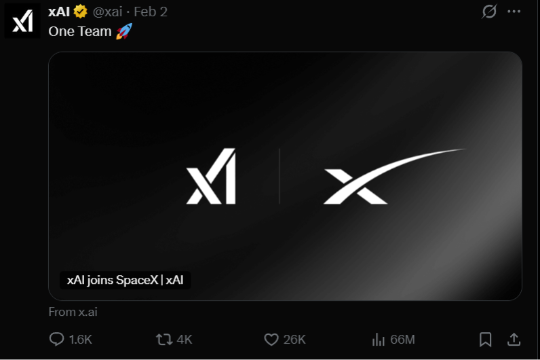
The takes rolled in fast. Many sounded like this:
"This is just Elon moving money around between his companies again—nothing burger!"
Sure.
And when Napoleon crossed the Alps, he and the boys were just making some minor adjustments.
So what’s the angle? What’s the point? What’s the next move?
Indeed, there’s an IPO thread running through this.
And there’s another interesting angle dangling upstream.
Why Does AI Want Rockets?
Why did Eric Schmidt—former Google CEO, safely retired, infinitely rich—suddenly decide to run a rocket company?
Not advise. Not invest.
Run.
In 2025, Schmidt took the helm at Relativity Space, a company that wants to 3D-print rockets instead of lovingly hand-assembling them.
People asked: “Why, Eric?”
We can safely surmise: Because Eric did the math.
By 2030, data centers alone could consume at least 10% of U.S. electricity production. Meanwhile, by all accounts, we’re heading into a tight power era.
Grid operators and the DOE warn that—at the current rate—by the late 2020s, regional shortages and frequent outages will become likely during peak demand or extreme weather.
Power grids will strain. Places to put data centers will run low. Permits will slow or stall. Neighbors will grab their pitchforks and revolt.
So Schmidt bought a machine whose sole purpose is to manufacture launch capacity at scale.
When Ars Technica’s Eric Berger asked him—half joking—whether this was about launching next-generation cloud infrastructure into orbit, Schmidt answered with one word:
“Yes.”
Altman, Google, China: The Math is Mathing
Sam Altman didn’t miss this.
In 2025, OpenAI quietly explored acquiring Stoke Space—a reusable rocket startup so early it barely qualified as a company.
Why would the CEO of an AI lab want rockets? Well, if your future compute lives in orbit, renting rides from your mortal enemy is out of the question.
The deal fell apart, but the intent was there.
Later, in November, Google announced its “Project Suncatcher,” an initiative to test prototype space data centers by early 2027.
Then, not long after, China showed its cards…
In January 2026, the Chinese aerospace firm ADASpace announced it had successfully run Alibaba’s Qwen-3 large language model aboard an orbiting satellite. A query was transmitted from Earth, processed in space, and the response returned in under two minutes.
Many treated it as novelty, but it was really a proof-of-concept for a much larger ambition.
In fact, the company said it outright: the test is a precursor to a much larger constellation, ultimately numbering in the thousands, developed with explicit support from China’s national space and AI planning authorities.
Different systems. Similar trajectory.
Intelligence, energy, and computation are drifting upward—away from crowded grids and terrestrial bottlenecks, toward orbit.
The Only Question Left
So here’s the WHY…
As intelligence multiplies beyond the human frame, the capacity to generate power becomes the capacity to shape destiny.
Orbital compute escapes many of Earth’s choke points—power, cooling, land, and politics—by tapping constant solar energy, more efficient radiative heat loss, physical inaccessibility, and effectively unbounded scale while moving at orbital velocity.
This won’t replace ground data centers. Latency still matters. Physics still matters.
So the architecture splits.
Reflexes will stay on Earth. Heavy thinking moves upstairs.
Millisecond decisions that can’t wait. Braking a car. Steering a drone. Stabilizing a robot. Anything where latency can kill you stays local, on-device, or on the ground.
Slow, expensive, power-hungry work moves up. Training models. Crunching massive datasets. Planning, simulation, optimization, coordination. The stuff that benefits from unlimited power, cooling, and space.
AI demand is software-bounded, not physics-bounded. Energy is physics bounded, not software-bounded. The “third thing” emerging out of this tension of opposites is space.
Others will follow.
So here’s one question for you:
Is your portfolio stuck on Earth? Or does it already have flight plans, too?