Jeeves Is Dead. Long Live Jeeves.

Posted May 08, 2026
Chris Campbell
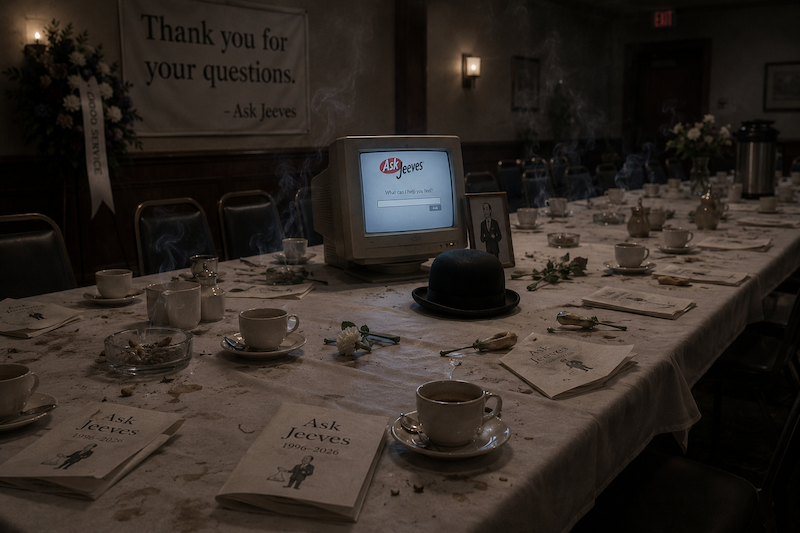
Ask Jeeves shut down on May 1. He was 28. He is survived by Bing.
The story didn't make the front page. It didn't make the back page. It barely made the comments section.
But, the thing is…
Jeeves was right.
Type a question. Get an answer. That was the entire pitch in 1996. You asked. Like a human.
Google buried the idea under a decade of "I'm Feeling Lucky" and ten blue links. An entire industry of keyword-stuffers and 2,000-word recipe intros built lake houses on top of the corpse.
Now look at what people are doing in 2026.
Typing questions into ChatGPT. Asking Claude to plan their week. Running multi-step research through Perplexity.
Doing exactly what Jeeves promised in 1996.
The technology was 30 years late, but the thesis was correct on day one.
Which brings me to what actually killed Jeeves.
5 Things Jeeves Didn't Have
A conversational interface needs five things to work.
Compute. Memory. Inference. Distribution. Data.
Jeeves had one of them. Distribution.
He had the AOL portal, the butler in the bowler hat, and a Super Bowl ad budget. That was the company.
The other four didn't exist in any form he could use.
Compute was a server farm running Pentium IIs. Memory meant a session cookie that died when you closed the browser. Inference was a pattern matcher pretending to understand English. Data was whatever pages had been indexed that week.
So when you asked Jeeves a question on Tuesday and asked the same question Wednesday, you got a cold start. Goldfish Mode. Magical for thirty seconds. Useless by the third question.
Jeeves was selling a 2026 product on a 1996 stack.
But the deeper reason he failed is the same reason every pre-revolution interface fails. The toll booths weren't built yet.
Toll Booths Always Win
Every interface revolution mints a new behemoth.
Command line gave us IBM. GUI gave us Microsoft. The web gave us Google. Mobile gave us Apple. Each time the old champion failed to make the leap.
The pattern is always the same. Build the layer underneath. Collect the toll. And when the interface changes, the toll booth relocates.
We are watching it relocate right now.
On Wednesday, Anthropic took every chip at SpaceX's Colossus 1 data center in Memphis. 220,000 GPUs, locked in within a month. The same afternoon, Musk dissolved xAI into SpaceX.
The combined entity has a new name. SpaceXAI.
Buried in the press release—Anthropic and SpaceX are exploring multiple gigawatts of compute capacity in orbit. If you believe Cathie Wood, the orbital data center business could dwarf Starlink.
That's the IPO pitch now. SpaceX isn't a launch company with a satellite division. It's an AI infrastructure company with a launch division—building the next toll booth in real time.
But, while the IPO is the headline…
We believe the real trade is one layer down.
It’s sitting in the supplier ecosystem, in the parts lists Wall Street hasn't read yet, in the small companies whose hardware quietly makes the Anthropic-SpaceX story actually work.
That's where this cycle's outsized returns live. In the names underneath that get repriced before most investors even know they exist.
That’s where we’re on the hunt.
Jeeves was right. He just couldn't get there from 1996.
The companies that can get there from 2026 are about to be very, very rich.