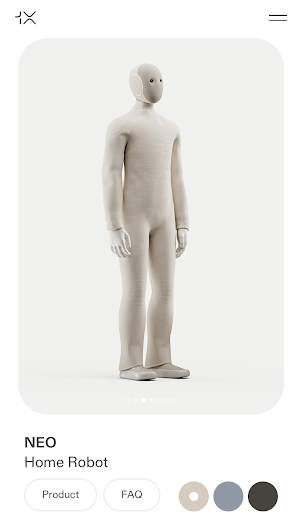
Meet NEO, Your $20,000 Robot Roommate

Posted October 29, 2025
Chris Campbell
1X Technologies just dropped what they’re calling the “world’s first consumer-ready robot designed to transform life at home.”
For just $20,000, your new roommate arrives in 2026.
His name? NEO.
On paper, it folds laundry, vacuums floors, and chats with you like your new best friend.
In reality? It’s a lot closer to a puppet than a partner.
Worse, the hype risks slowing the humanoid revolution it claims to lead.
Let’s pull back the curtain on NEO—because what’s behind it, and what it represents, is weirder than most realize.
(We’ll also talk about the real winner: the tech stack everyone’s ignoring.)
The Magic (and the Mirage)
Credit where it’s due: 1X built something that feels alive.
It’s wrapped in a soft, pliable skin instead of cold metal. It moves like it’s powered by tendons, not actuators.
It’s light enough for you to carry, safe enough for your kid to hug, and polite enough to “laugh” when you tell it a joke.
For a moment, it’s easy to believe.
You look into its weird little beady eyes and you can almost see the future…
Until, that is, you realize someone’s behind the curtain.
Because that’s the twist: most of what NEO does is still remote-controlled.
The folding, the tidying, the laundry? No AI magic there. A human pilot is behind every move, watching through a VR visor.
Those glowing LED “ears” that change color? They’re signals that an operator is in control.
So when you buy NEO…
You’re basically buying access to a telepresence service. The “robotic revolution” is still being puppeteered through Wi-Fi.
Global Labor Arbitrage 2.0
Officially, 1X says only expert staff will handle your chores. Robotics engineers. Specialists.
But if history is any guide, that promise won’t last.
Every new frontier technology starts with specialists and ends with scale.
Tesla’s Autopilot was trained by AI engineers… and now it’s labeled by low-wage contractors in Nairobi.
Amazon’s cloud AI was built in Seattle… and refined by gig workers on Mechanical Turk.
Soon, NEO’s telepresence feed—the “brain-in-the-loop” that teaches it what to do—will follow the same path:
From Palo Alto to the Philippines. From “robotics expert” to robot pilot.
In other words…
The near-future of humanoid robots is a guy in Dhaka, Bangladesh doing your dishes from a VR cubicle.
In other-other words: if there’s an opportunity here, it’s the telepresence tech stack.
That’s where companies like 1X, Sanctuary, and Figure are really competing in the near-term—not on autonomy, but on bandwidth, latency, and operator UX.
The Price of Pretending
1X calls this “hybrid autonomy.”
That’s marketspeak for “we want your data.”
Your home becomes the training ground for future AI models. Every spilled coffee and unmade bed is another labeled datapoint.
Even if you buy the NEO outright for $20,0000 (rather than “renting” it for $499/month)...
You’re paying to be part of a dataset. The same way early Tesla drivers paid to teach their cars to drive.
But the stakes here are higher.
This thing lives in your house. It sees your kids. It maps your bedroom. It sends everything back to the cloud—where engineers (and potentially anyone else who gets in) can watch.
They’re selling you “freedom from chores.”
What you’re really buying? Surveillance with a Scandinavian minimalist aesthetic.
The Coming Humanoid Hangover
If this flops—and it might—it won’t just hurt 1X.
It could set back the humanoid sector.
Because 1X isn’t framing NEO as a prototype. It’s pushing it as a public debut of our humanoid future.
The public perception is the humanoid industry is saying: we’re ready for your home now.
If NEO underwhelms—or, heaven forbid, becomes the “Fyre Fest of robots”—it may reveal how far we are from trusting them, or even needing them, in our daily lives.
Automated mass adoption depends as much on trust and narrative as it does on raw capability.
That’s the real risk: a false dawn that drains the dream.
The Verdict
NEO is a breakthrough, sure…
But it’s also an illusion.
It proves we can make robots that look, move, and act human. But it also proves we’re still early.
If you’re planning on buying one, buy it for the story… not just the service.
One day, it’ll be a collector’s object, a symbol of proximity to the frontier.
Like buying a first-generation iPhone or a 1977 Apple II, you’re paying to stand at the hinge point of a technological epoch.
But the real physical AI revolution?
It’ll more likely come from the desert, the sea, the factory, and the launch pad.
For now, I’ll probably just stick with the Roomba.