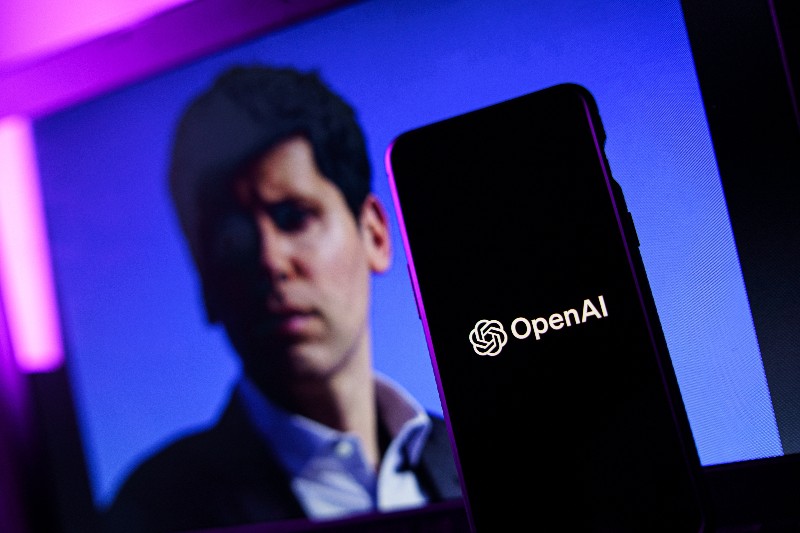
Sam Altman’s $1 Trillion Problem

Posted September 18, 2026
Chris Cimorelli
NVIDIA announced the H100 GPU in March 2022.
At the time, tech stocks were in a full blown bear market. Inflation was skyrocketing. War just broke out in Ukraine. That same month, the Fed started hiking rates.
By October, NVIDIA’s new chips entered full production. That same month, the bear market ended.
A month later, OpenAI launched ChatGPT – a large language model trained on more than 10,000 NVIDIA chips.
They caught lightning in a bottle. Within two months, the model attracted 100 million monthly users.
In May of this year, that number soared to 1 billion.
It is the fastest application in history to reach that mark.
And yet, somehow, despite all of this, OpenAI is losing the AI race.
Earlier this month, Sam Altman announced that OpenAI would no longer be pursuing an IPO in 2026. Earlier this year, the company was expected to go public at a $1 trillion valuation.
Meanwhile, its direct competitor, Anthropic, is planning an IPO for as early as next month which will value the company at $2-3 trillion. That’s two to three times more than OpenAI’s highest recorded valuation. It will also mark the single largest IPO in history, just months after SpaceX.
OpenAI started the AI race.
But they won’t be the ones to finish it.
This Math Ain’t Mathing
In 2025, OpenAI spent about $34 billion. Revenues? Just $13 billion. That means they lost $21 billion.
They’re basically losing almost $3 for every $1 they bring in.
You don’t have to be good at math – to know that math doesn’t math.
By January 2023, ChatGPT was all the rage. 100 million monthly active users.
The 2026 projections are even worse. OpenAI is expected to lose as much as $28 billion as costs scale.
And where are those losses coming from?
The answer – you and me.
Deadbeats Don’t Pay
I don’t know about you, but I don’t pay for ChatGPT. But I use it all the time.
I have an account. I open it a few times a week. Each query costs about 5 cents in electricity.
A billion people use the platform every month. Like me, most of them use it multiple times per month – even multiple times per week. The average person uses it about 10 times per month, give or take.
50 million of those users are paying customers. 50 million out of 1 billion. That means that 95% of OpenAI’s users are total freeloaders – like me.
When you chart out the math…
950 million users…
10 times per month…
5 cents per transaction…
You get a cost of about $475 million per month. From people who bring in zero revenue.
Managing these infrastructure costs remains one of OpenAI’s biggest operational challenges.
Quality. Not Quantity
Meanwhile, Anthropic took a different approach.
They don’t care about volume. They don’t need to cast a wide net.
They go after the users that matter.
Only about 20-50 million people use Claude – Anthropic’s large language model – every month. That’s one of the reasons why Anthropic has not become a household name. 20 million in a global population of 8 billion is a rounding error.
And yet, those users are very valuable. About 13% of its users pay for a subscription. That’s nearly three times better than OpenAI.
And over 50% of revenues come from large corporations. This includes over 70% of the Fortune 500 and the more than 1,000 corporate customers spending over $1 million annually.
Once Anthropic goes public, they’ll have to open their books for everyone to see. Going public is a sign of confidence. The board clearly believes Wall Street will see the trajectory and like it.
Which puts the spotlight back on OpenAI.
From Hero to Zero
While Anthropic is preparing to go public, OpenAI is delaying their IPO indefinitely.
Worthless users. Staggering losses. Lower growth trajectory.
If the company opened itself like this to Wall Street’s scrutiny, the stock would drop 80%. Its near $1 trillion valuation would evaporate.
The comparisons aren’t even close.
One company was founded more than a decade ago and claimed to grow revenues by 18% in Q2.
The other was founded just five years ago and more than doubled revenues in the same period.
It’s an easy equation – at this stage, if both companies were to go public, investors would dump OpenAI for Anthropic.
And this advantage will compound. A public corporation can raise money easily. If the company continues to grow as fast as it is, and occasionally dilutes shares to raise money, investors won’t mind.
Meanwhile, a private corporation like OpenAI does not have the same advantage. They have tighter lending standards, higher borrowing costs, and fewer eligible investors. And the ones who are eligible likely want to see some return on their investment before buying more.
Anthropic has already leapfrogged them. When they go public next month, it will create a gap that OpenAI will never be able to close.
Keep your eye on Anthropic. It’s about to become the most important technology company in the world. In a year, it will have the same name recognition as Palantir. In three years, it will be as well know as Amazon, Microsoft, or Meta.
And in a few months, it may even be the most valuable company in the world.