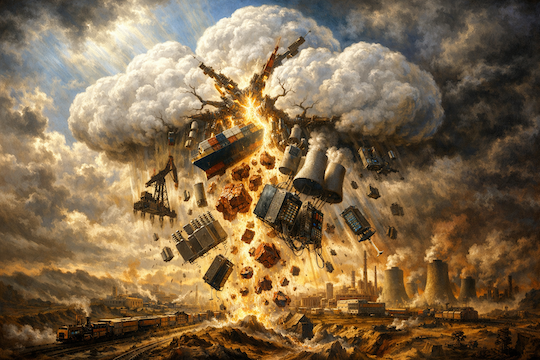
Software is Puking the World Back Up

Posted February 27, 2026
Chris Campbell
Three weeks ago, Bryan Cantrill walked into Jane Street with a confession.
Cantrill is an influential systems engineer and co-founder of Oxide Computer Company, which builds rack-scale servers—and the low-level software that runs them—for data centers.
His confession feels timely.
And not because Jane Street is the villain-of-the-week, with Reddit buzzing, X raging, and Bitcoiners circling.
That’s not this story.
(We unpacked the Jane Street saga—and its broader crypto implications—in today’s Early Stage Crypto Investor update. If you’re a member, check your inbox.)
This story begins in 2018…
When an engineer posed a question to Cantrill that, in hindsight, defines the 2026 tech debate.
More or Less: We’re Doomed
Back then, Cantrill addressed Jane Street on the one topic that gives seasoned engineers insomnia:
Complexity creep.
In short, modern computing keeps layering abstraction on top of abstraction—opaque firmware, vendor stacks, systems no one fully understands—and it’s getting harder to see the whole machine.
So when someone asked if that explosion of complexity would ever resolve, Cantrill shrugged and basically said no.
More or less: we’re doomed.
In 2026, almost a decade later, he came back to apologize.
NOT because systems got simpler, but because surrendering to complexity creep is a design choice.
It may sound technical. For investors, it’s a field of flashing signals.
Cantrill is pointing straight at a theme running through nearly every Paradigm letter right now.
Allow me to explain.
Software is Puking the World Back Up
In 2011, Marc Andreessen launched a thousand pitch decks with one line:
“Software is eating the world.”
Cantrill has been hate-reading that essay for fifteen years.
Not because it was inaccurate. Because it elevated software to a starring role it didn’t fully earn.
In his essay, for example, Andreessen declared that “Software ate photography.”
But… did it, really?
Consider the companies he hailed as proof: Shutterfly. Snapfish. Flickr. Groupon. LivingSocial. Zynga.
Today, they’re all relics of a moment—no longer the engines of disruption they were billed to be.
Meanwhile, companies rooted in atoms quietly compounded: NVIDIA. TSMC. Apple. Advanced Micro Devices.
Your iPhone camera is an orchestra of precision glass, sensor physics, signal processing, and silicon tuned at nanometer scale.
If software ate the world, in other words, it puked most of it back up.
The lesson? Not that software failed.
But that the software-only lens missed the stack.
Taming the Organism
Most server companies buy standard parts, bolt them together, install software on top, and ship it.
Cantrill’s team at Oxide Computer Company chose a harder path.
They designed their own boards. Their own switch.They wrote their own low-level operating system software. They control what happens—from the hard teeth to the soft tails.
Why go through the trouble? Because, says Cantrill, ghosts hide in the seams. And that’s the true cause of complexity creep.
A network card that fails for years because everyone unknowingly resets it twice. A firmware signal that never confirms a voltage change, leaving the processor stuck waiting. A brief power dip that resets every drive while everything else looks normal.
When you don’t control the boundaries, you inherit a whole lot of mysteries.
But the stack is one organism. You can’t reason about the head if you’re blind to the butt.
The Investment Angle
That’s where this becomes an investment story.
My colleague Adam Sharp over at The Daily Reckoning is pounding the table on a new acronym:
HALO: Heavy Asset, Low Obsolescence.
For fifteen years, investors crowded into “capital light” stocks.
As Adam writes, “Software is the poster boy here… once you build a software product, it doesn’t cost much to onboard new customers.”
Recurring revenue. High margins. Infinite scalability.
But, in his words, “Investors went overboard, bidding up these names to silly valuations.”
Now? “The script is flipping.”
The market has started treating asset-light names as soft targets: easy for AI to undercut and too richly valued to defend.
Even software king Microsoft is feeling the pinch.
Meanwhile, capital-intensive businesses—utilities, miners, drillers—are shining.
“These types of assets are very expensive to replicate. Sometimes even impossible,” Adam says.
Nobody wants a new power plant in their backyard. Nobody can conjure a copper deposit with a prompt. Software shaped the narrative. Now physics is setting the limits.
And when capital senses that constraint, it rotates. From abstraction premium to asset control. From narrative leverage to physical leverage.
From software-heavy to HALO.
Right now, the regime is still shifting.
That’s the deeper message behind Cantrill’s confession.
Software is retching the world back into view.
And the wise investor is holding its hair back, waiting to see what’s left.