THE $1 QUADRILLION PATENT

Posted May 19, 2026
James Altucher
Let me start with an unsexy truth.
It’s too boring for a headline, too obvious to argue with, and somehow still ignored.
The AI race will NOT be won by whoever has the smartest model.
I know that sounds wrong. Every headline is about models. GPT this. Grok that. Bigger, faster, smarter, every six weeks.
But models are not the bottleneck.
Chips are not the bottleneck either.
Energy is.
You can build the most powerful artificial intelligence the world has ever seen. Give it a name and a personality. And it will sit there doing absolutely nothing—because you can't plug it in.
That's where we are. Not five years from now. Right now.
Data centers already eat electricity like a small country. And AI adoption isn't slowing down. It's going vertical.
Every new model, every new user, every new agent doing someone's taxes or driving someone's car needs power. Enormous amounts of it.
The grid we have was not built for this. It was built for air conditioners and refrigerators and the occasional Christmas display. It was never built to run a digital civilization.
So here's the real question. The one almost nobody is asking out loud.
Where does the next generation of AI actually run?
It Sounds Crazy, But…
Elon Musk has been chewing on this for years. And his answer is not "build more data centers in Texas."
His answer is to leave the planet.
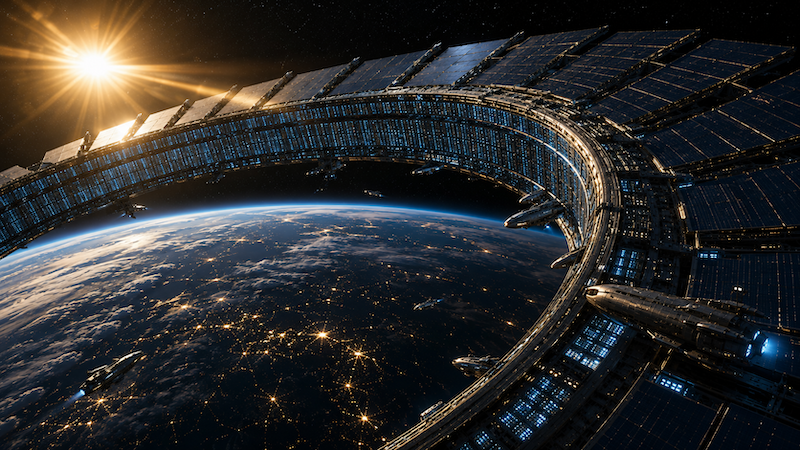
Move the compute into orbit.
Up there, the sun never sets. No night. No clouds. No winter. No grid to beg permission from. Solar energy in space is constant, brutal, and effectively free—the most efficient power environment human beings have ever had access to. And we are barely touching it.
If even part of AI compute moves up there, we're looking at a brand-new layer of infrastructure underneath the entire economy. The way railroads were a layer. The way the internet was a layer.
And Elon has actually put a number on it.
He believes this shift—space-based power feeding space-based AI—could unleash $1 quadrillion in new wealth.
Let me write that out so it lands properly.
$1,000,000,000,000,000.
That is not my number. I want to be very clear about that. That number comes from Elon himself.
At Tesla's last shareholder meeting, Elon said AI and robotics could grow the global economy "by a factor of 10 or maybe 100." Run the low end against world GDP and you land on $1 quadrillion.
And here's why he can say it with a straight face: This doesn't apply to one product. It applies to everything he is building.
The robotaxi network. The Optimus humanoid robots. Grok, and whatever comes after Grok. Every one of those runs on compute. And compute runs on power.
So the real bottleneck across his entire empire is power. Always power. Solve power, and you don't improve one product—you unlock all of them at once.
The Tiny Company On Elon’s Radar
SpaceX is heading toward what could be the largest IPO in human history. Elon has already folded xAI into SpaceX.
He's taking an entire ecosystem public.
And if you've watched Elon operate for twenty years, you know exactly what he does next.
When something is critical to his plans, he does not politely wait for the market to hand it to him. He buys it. He partners with it. Or he pulls it inside the tent.
He did it before. He'll do it again.
Which is exactly why I've been digging into one small company that already lives inside this world.
It already works with SpaceX.
It already has real, functioning technology in orbit—today.
It’s NOT a household name. You've never seen it on CNBC. Most professional investors couldn't tell you what it does.
But it is sitting on precisely the kind of technology a man building a trillion-dollar AI empire cannot afford to be without.
That hands it three ways to win: rising demand, deeper partnerships—and the one I keep circling back to, a buyout.
The company name, the ticker, and our full buyout analysis are not in this letter—and they're not going on a public page anywhere.
I put them inside a small beta-test I’ve recently launched.
Beta testers who join today get an early look at this company, plus the next wave of opportunities my team is already digging into.
Everyone else reads about these specific opportunities later, after the easy money is gone.
The link below is the only way in: