
The Case Against Doom

Posted February 10, 2026
Chris Campbell
“Soon, there will literally be nothing a human can do better than an AI or a robot.”
In the past few years, a once-strange notion has slipped quietly into polite conversation:
Humans are fast-approaching a moment when even our last scraps of comparative advantage will be cheerfully vacuumed up by machines—an idea now repeated online with the certainty usually reserved for the weather or the national debt.
That idea props up a great deal of modern doomposting, and it sits squarely at the center of Murad Mahmudov’s worldview.
But who is Murad? And how is he any different from a medieval firebrand who tried to cancel the Renaissance?
Let’s dive in.
The King of Memecoins
Murad, if you’re not familiar, has spent the last three years telling his 730,000 followers the system is terminally broken, rapid decline is inevitable, and the rational response is exit through memecoins—a last, ironic escape hatch from a system set to grind you to dust.
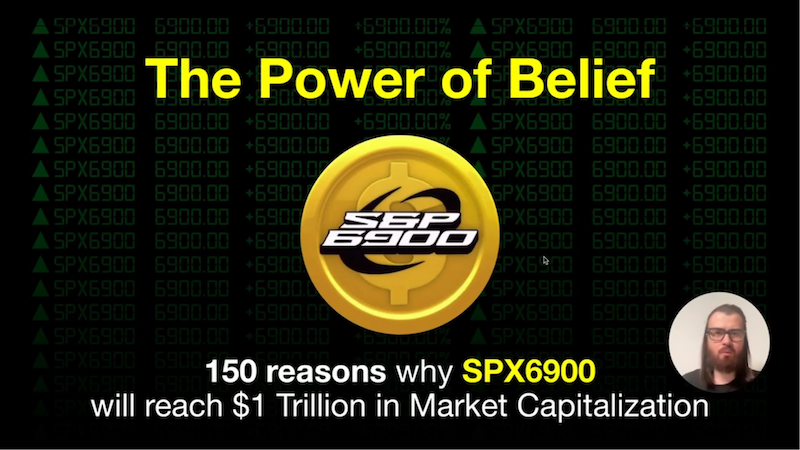
In his most ambitious presentation, “The Power of Belief,” he spent almost 2 hours laying out his bull case for a memecoin called SPX6900.
Inflation. Shrinkflation. Aging elites. Loneliness. AI replacing work. Declining mental health. A permanent underclass forming in real time.
According to Murad, these aren’t side effects of the system. They ARE the new system.
And once you give your mind over to that premise, the conclusion follows:
Traditional paths won’t save you, earnest investing won’t move the needle, and the only rational response is collective belief in something absurd enough to flip the table.
That’s the thesis.
Of course, a memecoin seems unserious. But it functions as a carrier for a rapidly spreading, very serious belief that’s beginning to permeate popular culture:
The system no longer deserves our participation.
Art of the Doom
Doomposting is popular because it turns confusion into certainty.
It takes a diffuse, low-grade anxiety—life getting harder, effort buying less, institutions aging in place—and turns it into a single story.
For Murad, memecoins resolve that unease by offering an exit narrative in place of a credible path forward.
He doesn’t bother framing memecoins as viable businesses, since all businesses are assumed to be rigged against you. Nor does he even talk about them as technologies, since technology is cast as the thing that replaces you.
He frames them as escape—ways to opt out psychologically and financially from a system that no longer rewards effort, skill, or participation. A way out of wage stagnation, credential decay, and a future where “doing everything right” still doesn’t work.
When systems falter, says Murad, belief travels faster than reason. If nothing is fundamentally fair, then shared meaning matters more than fundamentals.
Murad is far from alone here.
Despite his incoherent solution, he tells a coherent story.
That’s why this same story—from populist politics to AI panic to financial fatalism—spreads wherever people sense the systems governing their lives no longer respond to effort, voice, or participation.
BUT, if the past is any guide, prophets of doom are usually describing a transition in tension and calling it the end.
And following them commonly results in watching the future happen from the sidelines.
Burn it All Down
Every major transition produces the keen-eyed doomposter.
They correctly see the systems decaying, then conclude nothing adaptive can replace it.
Malthus thought we’d starve. Marx thought capitalism couldn’t adapt. Spengler thought the West was finished in 1908. Ehrlich thought population growth sealed our fate.
But it’s late-feudal Europe that offers us perhaps the most relevant historical rhyme for our time.
Take Girolamo Savonarola, a fiery Florentine friar who briefly took control over Florence by preaching apocalypse… before being swallowed by the system he tried to burn.
Savonarola looked at Florence in the 1490s and saw everything Murad sees now:
→ elites hoarding wealth
→ institutions losing legitimacy
→ culture feeling hollow
→ people priced out of dignity
Feudal order was breaking. The Renaissance was just forming. He saw the cracks clearly—and tried to seal them instead of stepping through.
His solution was similar to Murad’s:
→ collective belief over development
→ symbolic unity over structural change
→ burning objects rather than redesigning systems
Burn it all, he said—the literal bonfire of vanities. Cultural artifacts to the flames. Books to the ovens. Art to the pyre. Symbols of decadence sacrificed in public.
Return to shared faith.
Murad looks at AI, inequality, loneliness, and job collapse and reaches a similar conclusion…
The only viable response is collective belief in a single unifying object, not as a bridge to a new system, but as a stand-in for systems themselves.
It’s the same speech Savanarola gave:
The order is foul, opt out entirely.
Savonarola’s followers refused to build or see what was being built. They chose to burn.
History was unforgiving.
The Other Side of the Coin
Thing is, the weakening of feudal order was visible long before it collapsed. A small minority noticed the signals early and didn’t moralize or panic.
They redirected effort and capital into useful, scalable primitives: trade networks, credit, accounting (double-entry bookkeeping), information (printing press), logistics, skills.
Those who followed those trends instead of the doomposters thrived. Not uniformly. Not without risk.
But overwhelmingly.
Moreover, this transition made possible a world organized around scalable coordination rather than inherited authority.
It set the foundation for global trade, modern science, industrialization, corporations, financial markets, mass education, and modern states to emerge.
History favored those who adapted early, not those who announced the end.
The End of the End (of the End)
In hindsight, declaring total breakdown becomes a lagging indicator of transition already underway.
If we accept that frame, the current one may also enable new forms of work, capital formation, governance, and creativity that operate outside traditional jobs, credentials, and institutions.
The risk of rejecting decay-as-destiny is limited, while the upside remains tremendous.
Traditionally, the winners don’t shout that everything is broken. They ask a quieter question:
If the current system no longer coordinates reality well, what replaces it?
Then they move.
The trickiest part? The transition happens outside of announcements or public debates.
It happens on the fringes. Where even weirder and wilder things live. And where other, more mundane things, die.
Like the Roomba.
But more on that tomorrow.