
The Case for Avoiding Crypto in 2026

Posted December 22, 2025
Chris Campbell
Not long ago, crypto was stuck in financial nihilism.
Nothing mattered. Everything was a meme. Value itself was a joke.
First, it was implied.
Then, with the rise of memecoins like $NOTHING, it became explicit.
There was no utility, no future, just acknowledgment that the idea of value itself—in all markets—had fully collapsed into irony.
The final death knell was probably when Yahoo Finance published an article about USELESS, a useless memecoin that had reached a $100 million market cap.
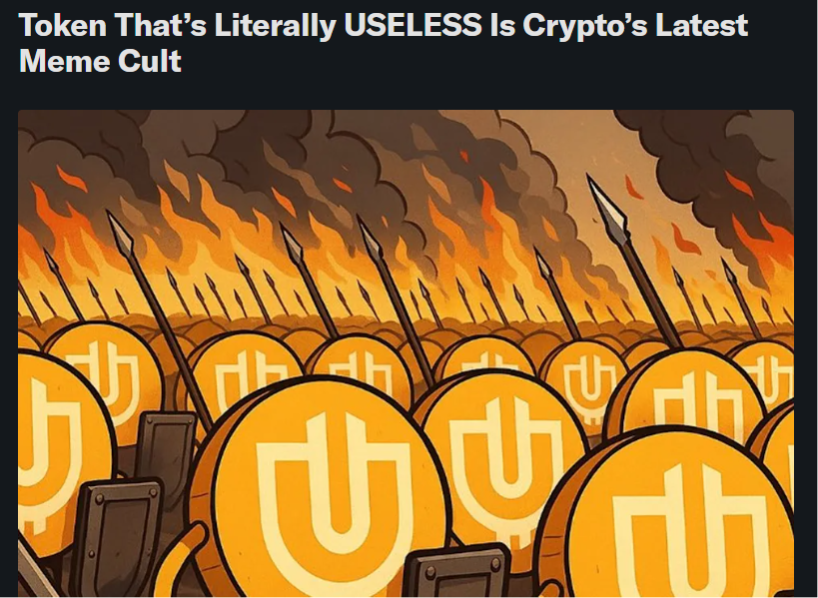
That was the underlying mood of the memecoin craze.
That mood has… like moods do… mostly passed.
As Haseeb Qureshi, managing partner at Dragonfly, rightly observed, it’s given way to a different mood…
Financial cynicism.
The new spirit goes like this: maybe some of this stuff has value, but it’s overpriced.
It defaults to a single test… value them like businesses, see what survives.
Today, let’s step back and look at both perspectives—the bullish case and the cynic's case—evenly.
And see why it might make perfect sense to sit crypto out in 2026.
(Or does it?)
Back to the Future
Let’s lay out the two camps cleanly.
For a long time, blockchains were not compared to businesses. They were seen as neutral settlement layers other businesses, markets, and instruments build and live on top of.
This framing put blockchains in the same mental hollows as operating systems, protocols, and base networks, not firms.
And if blockchains live in a “settlement infra” bucket, then valuations will continue to look uncomfortable, indefensible, and premature—right up until they don’t.
Because?
Their economic relevance is determined by how much activity they will intermediate over time, not strictly by how much profit they extract in any given quarter.
And?
If public blockchains intermediate even low single-digit percentages of global settlement flows across payments, securities, and collateral, the economic surface they sit on is measured in tens of trillions annually.
But?
The moment you demand backward-looking valuations as the primary justification, you’ve collapsed the time horizon.
You’ve decided the system is mostly built, the addressable surface is mostly known, and growth is now incremental and linear.
Yes, there’s a non-zero chance you’re correct.
And if you are correct, and you still invest, you’ll earn—AT BEST—normal, banal returns in 2026, if you’re lucky.
Therefore, sitting it out in 2026 is the rational play. You can earn comparable or better risk-adjusted returns elsewhere with less noise and fewer unknowns.
But what if you’re wrong? What if you’re betting against exponentials? THAT’s the question.
Probability Is Not Wishful Thinking
Markets price probabilities, not certainties.
A biotech drug with a small chance of curing Alzheimer’s can be worth billions. Most of the time it fails. That doesn’t make the pricing irrational.
Blockchains follow the same logic:
Even if most networks stagnate or fail, a small number that become critical financial infrastructure justify larger-than-average valuations today, because the economic surface they may eventually intermediate is vast.
The core assumption driving today’s cynicism: even if that’s true, it won’t be worth much more, given current metrics.
The contrarian view says something else: crypto is still in an exponential phase.
The moment you allow even a modest probability that crypto is still in an exponential adoption phase, standard business valuation becomes the wrong tool.
Exponentials are priced on surface area, not margins.
Exponentials don’t look impressive early. They look messy. They look inefficient. They invite premature valuation frameworks. But most early frameworks miss the point.
Imagine valuing the internet by dial-up fees, or electricity by early utility margins. Those fees were real. They mattered. They just weren’t reflective of the bigger thing being built.
When the systems kept growing, scale overwhelmed early inefficiency.
Scale changed the economics. Optionality compounded. New uses appeared. What looked like inefficiency revealed itself as early-stage underutilization.
Giving up on that idea means you’ve already decided the ceiling is low. That crypto’s growth is now linear.
That it might integrate politely into the existing financial system, but it won’t replace anything substantial.
Again, you might be right. But here’s the other side of the bet…
What Chains Actually Do
Crypto turns financial assets into software. It makes markets global, continuous, interoperable, and open.
Over time, open systems tend to have an unfair advantage. They generate more activity, more innovation, more participants. Resistance slows them down. It doesn’t stop them.
The financial cynics in crypto still believe in growth, just not in transformation.
They believe in products, not platforms. Revenue streams, not financial rewiring. Linear models, not exponential systems.
But this might just be another mood. Moods compress imagination, but they don’t permanently override incentives, adoption, or structural advantages.
Believing in crypto means believing its incentives and openness keep expanding the systems… beyond what most expect.
It means believing the most important phase hasn’t arrived yet. That belief used to be normal in crypto.
Right now, in some circles, it’s unfashionable.
But markets don’t reward fashion. They reward patience.
If crypto’s exponential continues, today’s prices for certain assets will look tiny in hindsight.
And for no other reason than the systems underlying them kept growing after most stopped believing they would.
That’s the bet.
In the end, of course, it’s up to you to pick the red or green bean…
- Sitting out 2026 is rational if you believe the ceiling is low.
- Staying exposed is rational if you believe the ceiling remains unknown.
I think you know which bean I’m eating.