The Dull Man’s Dollar

Posted May 22, 2026
Chris Campbell
Jeremy Allaire is a pretty dull man.
I mean nothing against him by that. Dullness, in his line of work, is a boon.
He runs Circle, the company behind a digital dollar stablecoin called USDC.
He is calm, mild, faintly professorial.
He will not promise you a lake house.
Instead, put him on a stage and he will explain reserve composition until the front row checks its phones.
Keep that in mind, because it matters.
First, let’s talk about stablecoins.
The Three Rs
There have been many objections to stablecoins.
Three of the sharpest are genuine. They have also, quietly, lost a couple fangs.
Reserves. Rails. Regulators.
The three Rs.
Reserves. For years the fear was sound—Tether, a giant stablecoin running on vibes, a bank with no audit and a custodian nobody could name. But USDC, the dull man's dollar, now parks its reserves in a registered government money-market fund that reports what it holds. The GENIUS Act hands the whole category a rulebook: full backing, cash and short Treasury paper, nothing maturing past 93 days.
Rails. "The dollar is already digital," said everyone. True. But your banking app is a polished face on 1970s machinery—weekday hours, three-day settlement, a toll collected at every gate. A dollar that clears in seconds, at any hour, without asking three middlemen for permission is a different animal, even when the number on the screen looks the same.
Regulators. The skeptics assumed Washington would turn up to strangle the party. Washington did turn up. It catered the party instead. Washington blessed it because the thing serves the Treasury. The most honest reason on the table, and it cuts both ways.
But here’s the most important objection…
The Sci-Fi Leotard
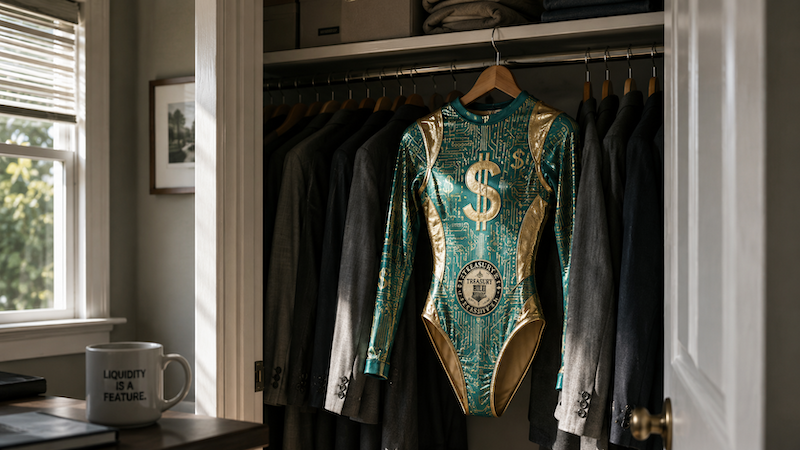
The pitch—autonomous robot agents will transact in an "agentic economy"—arrives in a science fiction leotard.
But take the leotard off.
Underneath is a plain thesis:
Software already moves money. It is about to move a great deal more of it, far faster, and the card networks and wire systems can carry that load about as well as a garden hose carries a flood.
You do not have to believe in a robot utopia (or dystopia).
You only have to believe that machine-driven transactions go up from here.
If they do, they need a rail that settles in seconds and never closes. There are only a handful of those in the running.
Pull Back the Curtain
I am a bull on stablecoins. You probably knew that walking in.
But notice what kind of bull I am…
What I’m saying is this: The dull thing is winning. Quietly, completely, with no fireworks at all.
Yet… pay attention to what it's quietly doing.
Every dull dollar has to live somewhere. It settles on a blockchain, clears on a blockchain, moves on a blockchain—and the blockchains were never the dull part.
The boring dollar is a tenant. It is dragging hundreds of billions of real, legal, institution-approved dollars onto networks it does not own and cannot control.
That is the opportunity. The networks underneath it. The crazy man’s option: crypto. The dull dollar wins first, and quietly. The rails it rides win bigger, and later.
Indeed, the dull man spent a decade making digital dollars safe enough for a banker to touch. He built the stage. But he is not the show.
But there is a way to spot the show early:
Find the most boring man in the room. Then walk past him, to the chains that pull the curtain back.