
The Pentagon's Banned Bitcoin Bible

Posted April 29, 2026
Chris Campbell
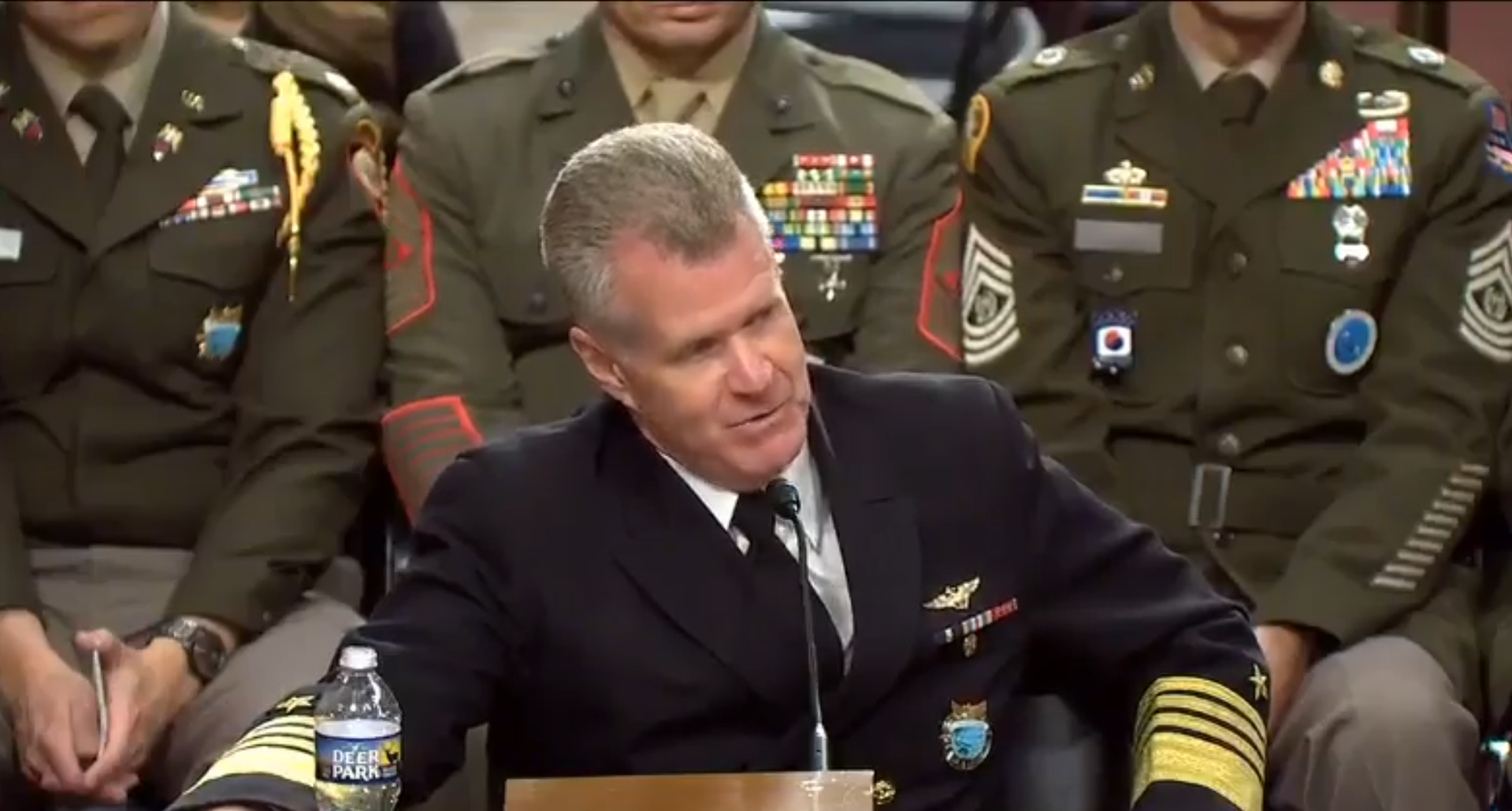
Admiral Sam Paparo isn't a backbencher.
He runs U.S. Indo-Pacific Command (INDOPACOM)—the largest combatant command in the American military, covering everything from the West Coast to the Indian Ocean.
His job is to deter China, contain North Korea, and watch Russia's eastern flank. Three of the four nation-state threats the Pentagon loses sleep over sit inside his area of responsibility.
Which is why what he said last week matters…
He told Congress—casually—that the U.S. military is running a Bitcoin node.
Not for treasury reasons. Not for "digital gold." Not for any of the arguments Bitcoiners have been hauling up to Capitol Hill since 2013.
For cybersecurity.
If you’re new to Bitcoin, this probably reads like noise.
But hang with me for two minutes.
Because the mainstream case for crypto is getting rewritten. And what gets rewritten next is which corners of this market actually matter.
The Bug in Paparo's Ear
Paparo didn't invent the idea.
He inherited it.
In 2023, a Space Force major named Jason Lowery published a 400-page MIT thesis called Softwar: A Novel Theory on Power Projection and the National Strategic Significance of Bitcoin.
When it went viral on Crypto Twitter, he published it into a book.

The argument: Bitcoin is a new form of physical power projection—a way to impose real-world energy costs on digital attacks, the same way antlers impose biological costs on rival bucks.
Non-lethal. Non-kinetic. Strategically significant.
Lowery called it the cyberspace equivalent of an offset strategy—how the U.S. won the last Cold War, applied to the next one.
The strange part:
Within only five months of Lowery releasing the book, Lowery tweeted that he’d been “ordered to take SOFTWAR down & asked to stop talking about the subject publicly.”
The book was pulled from Amazon, Google, Thriftbooks, the MIT Press site, and removed from the MIT library’s inventory.
For a while, you could only buy it on Ebay for no less than $350 (at which time I considered selling my copy).
Three years later, the four-star running INDOPACOM admits he’s testing it.
The Sidewalk Trick
Here's the use-case in plain English.
Imagine wet concrete. You scratch your name and the date into it. It hardens. Twenty years later, anyone walking by can verify exactly when you were there.
To rewrite that history, someone would have to jackhammer the entire slab in broad daylight—loud, expensive, impossible to hide.
Bitcoin does the same thing for digital messages.
You take a document, a contract, a military command—and you create a cryptographic fingerprint called a “hash.”
That fingerprint goes into a block. Twenty minutes or twenty years from now, anyone can pull the block, compare hashes, and know with mathematical certainty whether the message was tampered with.
One byte off. One comma added. The fingerprints don't match.
To forge that record, an attacker would need to execute a 51% attack on Bitcoin—roughly doubling the global hash rate.
This would cost billions. It would take a long time. And every node operator on Earth would see the attack happening in real-time.
This is what the Pentagon is testing. Tamperproof command-and-control signals. The kind you send when you're ordering a strike or routing missiles or moving troops in the South China Sea.
Why This Matters
The military has had secure comms since the Cold War. So why does a four-star need a public ledger to verify orders that already travel through the most hardened networks on the planet?
Paparo didn't spell this out in the hearing. He didn't have to.
Anyone who's read Lowery's thesis and watched the last decade of Chinese cyber operations can fill in the blanks.
Here's the scenario INDOPACOM plans against.
Day one of a Pacific war, China hits the satellites, the undersea cables, and the GPS timing signals at the same time. Three things break at once.
Networks fragment. Carrier groups lose contact with headquarters. Forward units lose contact with each other. The chain of custody that says "this order came from a four-star, signed with this key, routed through this server" breaks—because the four-star, the key server, and the routing infrastructure are all degraded.
Adversary implants activate. China has been pre-positioning inside U.S. networks for a decade. Volt Typhoon, Salt Typhoon, the whole campaign. Day one, those implants start corrupting logs, spoofing routing, and rewriting audit trails. Traffic that looks legitimate. Records that appear clean. Nothing you can trust.
Encryption alone won't save you. A compromised key still produces a properly-signed message. Cryptography proves the sender had the key. It doesn't prove the message is real.
This is the gap Bitcoin fills.
Not because of blockchain magic—because it's the only timestamping system on Earth no adversary state can corrupt, rewrite, or take offline.
Which is why Paparo isn't just studying Bitcoin. INDOPACOM is running its own node. They verify every block themselves, against the rules, on their own hardware. No commercial intermediary. No trust.
In the day-one scenario, the node is the one piece of infrastructure that doesn't depend on anything China might break.
To be sure, Lowery's thesis was bigger than just verifying data.
He argued proof-of-work is a new domain of warfare—a way to project physical power into cyberspace the way navies project it into oceans. Civilizational stakes. An "electro-cyber dome" over the entire internet.
Paparo only testified to the part that fits in an unclassified hearing.
What This Means For Bitcoin
The narrative just expanded.
Bitcoin's pitch in Washington has been monetary—pay down the debt, beat inflation, strategic reserve. Fine arguments. Limited audience.
Now Bitcoin walks into rooms where the conversation is about beating China.
Watch for the Mined in America Act. Roughly 97% of Bitcoin mining hardware is built in China. The same machines the Pentagon would be relying on for cyber defense.
Lummis and Cassidy want to onshore the hardware.
Make American miners the default. If Paparo's framing takes hold, this bill takes on a different cadence.
What This Means For Crypto
For the broader market—it changes the political center of gravity.
For fifteen years, every pitch crypto made was laughed out of the room. Magic internet money. A Ponzi. A solution in search of a problem.
Now the four-star running INDOPACOM tells the Senate Bitcoin is a "valuable computer science tool" for mission-critical networking—and the Pentagon is running its own node to prove it.
Mining hash rate is strategic. Node distribution is strategic. Energy policy, chip supply chains, even the boring DePIN pitch we've been making for years—all of it gets a new vocabulary.
The monetary case for Bitcoin was always going to win some hearts. The national security case is what begins to change the conversation.