Warning: Dark Labs on the Rise

Posted June 22, 2026
Chris Campbell
Since about 1950, the number of new drugs you get per billion dollars of research has halved roughly every nine years.
Adjusted for inflation, that's an eighty-fold decline.
Drug research has run Moore’s Law in reverse—costs double, output sinks.
The economists who noticed gave it a fitting name: "Moore" spelled backwards.
Eroom's Law.
Unlike Moore’s Law, nobody writes obituaries for this one, because it has never once failed to deliver.
Here’s why every investor should care:
Because a cure for it would be one of the largest markets on earth. But the real spoils go to whoever realizes this one thing first: AI isn’t enough.
The Next Leg of AI
AI researchers have spent years teaching computers to think about molecules—to guess how a protein will fold, to dream up new ones by the million.
The thinking got cheap and fast, but the hands-on part never sped up at all.
A molecule that looks perfect on a screen still has to be built for real. Mixed, heated, tested, then built again with one thing changed, hundreds of times over.
That's where everything slows down, in three ways.
Too many knobs. A reaction has half a dozen settings—heat, timing, how much of each ingredient—and they all pull on each other. A person can only hold two or three in their head at once, so the chemist freezes the rest and changes one at a time. The winning combination is usually the one nobody got around to trying.
Wasted failures. When an experiment flops, it often gets tossed and forgotten. But the flops are exactly what a computer needs—they map the cliffs. Show it only the wins, and it walks right off the edge.
Vanishing clues. The molecules that decide how a reaction ends last only seconds before turning into something else. By the time someone carries the sample to the machine, the witness is already dead.
Cut through the economics and Eroom's Law comes down to one thing: We got brilliant at thinking and stayed clumsy at doing.
But the doing is where the real money lives.
The Rise of Dark Labs
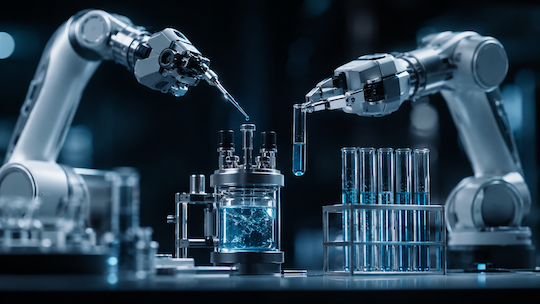
Picture a pair of arms, a reactor, an instrument that never blinks, and a small intelligence model running one loop—run, watch, learn, adjust, repeat.
The AI is both performing and watching the reaction live, catching the short-lived molecules before they vanish, logging every failure, choosing the next experiment on its own.
You’ve heard of dark factories. These are dark labs, also known as “self-driving labs.” They run experiments autonomously, 24/7, with minimal human supervision.
While most investors are still chasing the mind—models, chatbots, and wrappers—the next wave is the body: The hands and eyes that let intelligence touch something physical.
Where I’m Looking
Eroom's Law has never broken. Seventy years, no exceptions. Betting on a cure has turned large fortunes into small ones.
So I won't say this time is different.
But I will say this:
Every version of that law assumed a person at the bench—human speed, human hands. It's a portrait of human limits.
For the first time, though, the thing at the bench isn't going to be human.
I’m looking at three things:
- Toolmakers, selling the machinery rather than betting on a single molecule. You don't argue about who sells the shovels.
- Whoever owns the eyes. Plenty of companies are building robot hands; far fewer can let a machine see inside the flask in real time, before the witness dies. The eyes make the loop intelligent. That's the moat.
- On-premise. A drug company won't ship its crown-jewel chemistry to a stranger's cloud. Run the intelligence inside the firewall and you lock out half the field.
Companies that fit within one or all of these frameworks are set to win the rise of dark AI labs.