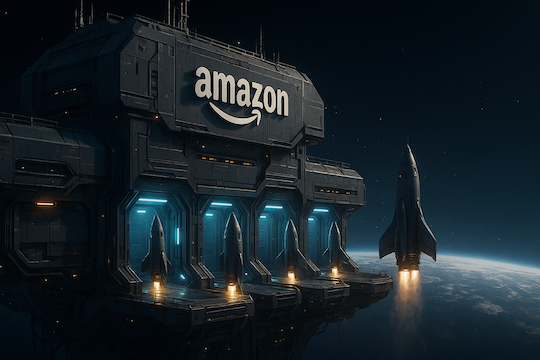
Amazon… But in Space!

Posted October 31, 2025
Chris Campbell
Most people know Amazon for the smiling boxes on their doorstep.
Few know its true power came from a side experiment.
In the early 2000s, Amazon’s engineers hit a wall.
Every new feature for the retail site required rebuilding the same foundations—storage, databases, compute power—from scratch.
Jeff Bezos called it “undifferentiated heavy lifting.”
To fix it, his team launched a shared layer of internal infrastructure. Modular services that any Amazon team could plug into instead of rebuilding from zero.
It wasn’t called “the cloud,” and it wasn’t meant to be a business. It was just a way to make Amazon itself move faster.
But then, during a 2003 off-site, Bezos and his top team had an epiphany: if Amazon needed these tools, so did everyone else.
AWS is Born
In 2006, Amazon Web Services (AWS) launched quietly, largely as a side project—a way to rent out excess server capacity they’d built for the retail site.
From the outside looking in, it seemed like a pretty dumb idea.
“WHY ON EARTH would anyone trust their core computing to a company that sells books and blenders?”
Even inside Amazon, some executives thought it was a distraction from the core retail business.
But AWS solved a pain point every startup had: the cost of building infrastructure.
Before AWS, if you wanted to launch an app, you had to buy or rent servers, find space, wire them up, hire sysadmins, and pray you could scale.
AWS turned that fixed cost into a service.
Compute on demand. Pay by the second. Scale like never before. Bing. Bang. Boom.
Early adopters—Netflix, Airbnb, Dropbox—realized they could scale to millions of users without ever touching a data center.
By the time the world noticed, it was too late: AWS had already become the backbone of the modern internet.
Today, it runs roughly one-third of all global cloud workloads, powers many AI training pipelines, and throws off tens of billions in annual profit…
More than all of Amazon’s 2024 retail margins combined.
And it all began as an internal tool no one took seriously.
(Will the party last forever? No, but that’s a story for another day.)
Now, here’s the thing…
Elon Musk is running a VERY similar playbook, just off-planet.
Amazon… But in Space!
Sounds weird, but think about it:
SpaceX began as a rocket company. That’s the storefront… the “bookstore” phase.
But what Musk is really building is infrastructure:
- Reusable launch vehicles = logistics backbone.
- Starlink satellites = orbital data network.
- Starship = heavy freight layer for cargo and energy.
- Autonomous docking and refueling = supply chain.
Every rocket launch is another line of code in Musk’s megacloud—except instead of servers, his infrastructure lives in orbit.
Like AWS, SpaceX started as a way to serve his own needs: cutting the cost of getting payloads into orbit.
At first, Musk just wanted a greenhouse on Mars.
When he realized the launches alone would cost more than the entire project, he scrapped the plan. He decided the real play was building a rocket cheap enough to get there.
Now? SpaceX is quietly becoming a service layer for the entire space economy.
Governments, defense agencies, telecom providers, and AI networks are already paying SpaceX to “rent” bandwidth, launch slots, and global coverage… the physical equivalents of cloud computing.
Starlink, for instance, isn’t just beaming internet to rural cabins and yachts. It’s supplying battlefield connectivity in Ukraine, backup comms for airlines, and redundancy for corporate data flows.
If AWS became the backbone of the internet, SpaceX is becoming the backbone of the planet.
And, one day (as we talked about yesterday), the interplanetary network beyond it.
The Quiet Part Blaring
When AWS launched, Amazon didn’t blast it out to the public. They didn’t need to.
Developers discovered it, used it, and built billion-dollar ecosystems on top.
SpaceX is in that same quiet phase.
The public sees rockets. The smart money sees a mesh network of orbital compute nodes and autonomous supply lines.
Every single time, it’s the same old pattern…
The world laughs first, then pays monthly.