
Musk Hides the Map in Plain Sight

Posted October 30, 2025
Chris Campbell
“If you look on your Starlink WiFi router,” Elon Musk said on stage at his Starbase update, “you’ll see this image.”
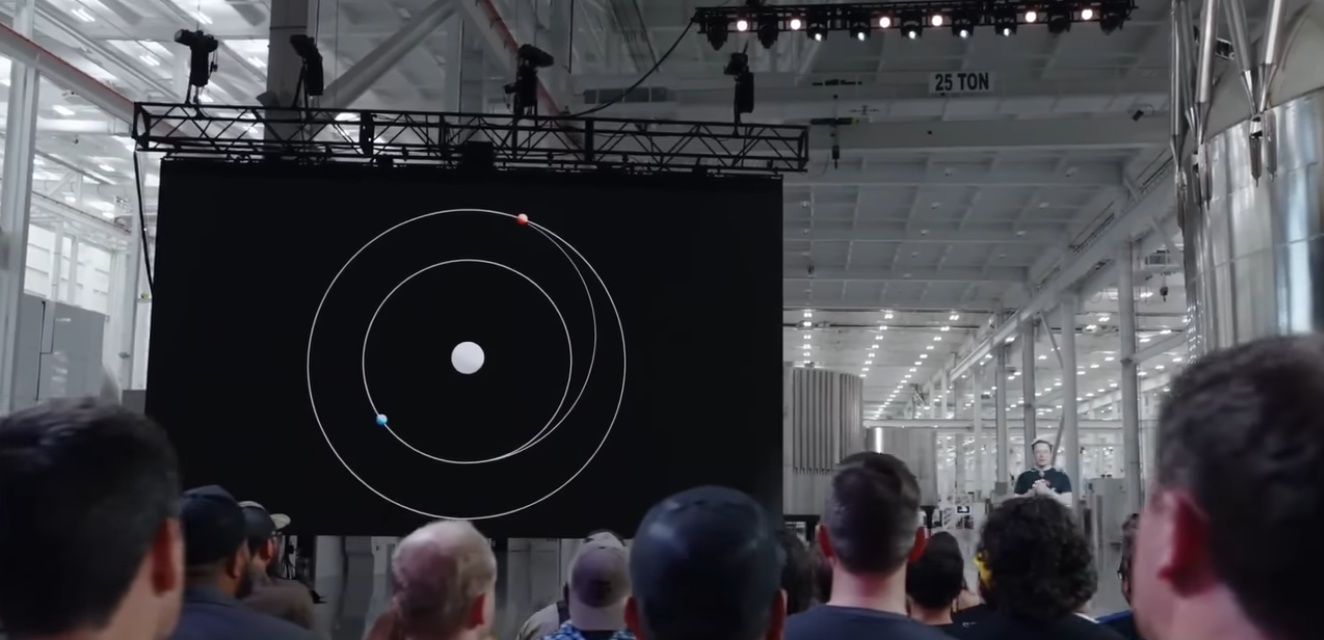
The image he showed was a map of how a spaceship gets from Earth to Mars.
You can’t just aim at Mars.
Instead, the ship must follow a long, curved path that uses the least amount of energy possible… and at exactly the right time.
So why is this image on your Starlink router?
“Because,” said Musk, “Starlink internet is what’s being used to pay for humanity getting to Mars.”
Musk’s Master Plan
In July 2024, we published an article in Paradigm Mastermind Group (PMG)—called “Musk’s Master Plan”—with one bold claim:
Every one of Elon Musk’s companies is a subsystem of a single mission: to build a civilization on Mars.
A unifying theory for what looked like chaos: Twitter drama, humanoid robots, brain chips, tunnels, rockets, memecoins.
The deeper we looked, the more the pattern emerged.
The Cybertruck wasn’t just a car; it was a pressurized rover built from the same stainless steel as Starship.
The Powerwall and Megapack weren’t just energy products; they were prototypes for ultra-terrestrial self-sufficient power grids.
Humanoid robots? The first settlers, readying the habitats before humans arrive.
Starlink wasn’t just broadband; it was the foundation for a multi-planetary internet, bridging Earth and Mars through Lagrange-point satellites.
The Boring Company’s tunnels? Dry runs for subterranean habitats, radiation-proof and thermally stable beneath Martian soil.
Even Dogecoin and the X “everything app” hinted at something stranger—a prototype for interplanetary payments.
Since then, that “one-mission” theory of Musk’s empire has caught fire.
Now? Not So Crazy
The Guardian ran a piece suggesting that the world’s richest man isn’t improvising but executing a long-range plan “to make humanity multi-planetary.”
The Wall Street Journal called it “Musk’s Mission to Take Over NASA—and Mars,” arguing that his private partnerships and super-heavy launch infrastructure are “laying the scaffolding for a second civilisation.”
Brookings followed with “Musk’s Mars Idea Is Not Crazy,” a sober policy essay treating his multiplanetary vision as a credible model for resilience.
Even The Generalist and Newsweek have picked up the thread, describing Musk’s overlapping companies as a kind of “industrial nervous system” linking energy, compute, transport, and intelligence.
Now, here’s the thing…
When Musk took the stage at Starbase, he finally laid out the blueprint.
The Master Plan
The numbers are astronomical (literally): 1,000 to 2,000 Starships per launch window, each hauling tens of tons of cargo.
The goal? Roughly a million tons of payload on the Martian surface by 2040—the threshold he believes will make Mars self-sustaining.
To get there, it will follow this sequence:
- Automate first. Send Optimus robots to build, map, and gather data.
- Human test phase. Two years later, send crews to establish basic infrastructure.
- Scale and sustain. Multiply tonnage and build the first permanent city—powered by solar arrays, stabilized by tunnels, and connected through Starlink.
The pieces finally fit.
Starlink funds and connects the colonies. Tesla’s energy storage keeps them alive through dust storms.
The Boring Company’s tunneling tech provides radiation-proof shelter. xAI and Tesla’s supercomputers evolve into the AI control layer for robotic and human collaboration.
Even Neuralink plays a part: human-AI telepresence for Mars operations. (Hey, maybe NEO is onto something after all.)
What once sounded like scattered moonshots—cars, robots, rockets, tunnels, satellites—is crystallizing into a phased industrial plan.
Is it possible? Yes.
Investable? Doubly so.
BUT…
The smart move isn’t to bet on Mars itself, but on the infrastructure stack beneath it: satellite networks like Starlink, grid-scale batteries, humanoid robotics, advanced manufacturing, and AI compute.
These are the “railroads and telegraphs” of the 21st century. Assets that will power both the Martian economy and Earth’s next productivity boom.
In short: invest in the Earthside assets of a multiplanet future.
More soon.