BOTFLATION!

Posted September 03, 2026
Chris Campbell
Price-fixing is one of the oldest tricks people run on each other.
Roman grain merchants did it. The medieval guilds did it. Whisky distillers did it. OPEC does it in the open and dares anyone to complain.
Adam Smith warned us first: tradesmen can't share a drink without the conversation drifting toward robbing the public.
For three thousand years it took the same thing—a meeting, a wink, somebody willing to say the words out loud.
Then, in 2017, something new happened in Germany.
A few gas stations started fixing prices with no meeting and no intent—and no law able to touch them.
Welcome to Botflation.
Payment bots, like the ones we met in yesterday’s article, are coming whether you like it or not.
Here are three stories you should know first, one opportunity worth watching, and how to keep your wallet safe.
Germany's Silent Cartel
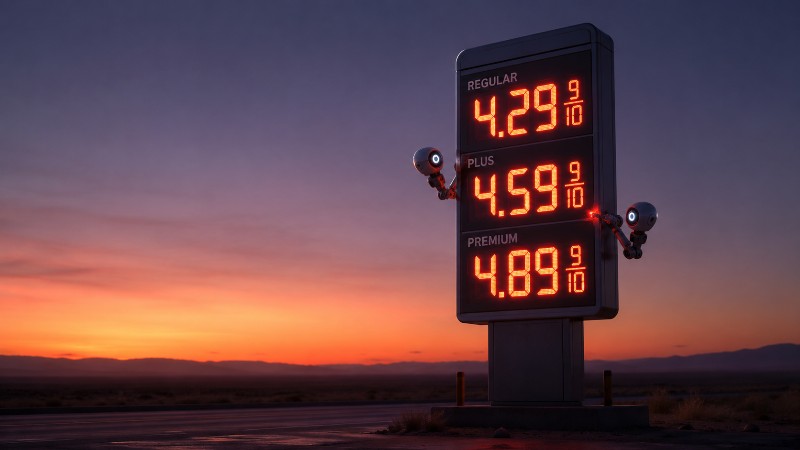
In 2017, gas stations all over the country handed their prices to software.
The algorithms watched the weather, the wholesale cost, and one another, then set the number on the sign by themselves.
Economists noticed sporadic price jumps, so they went digging.
On a stretch of road with two stations, if one ran the software, nothing much happened. If both did, margins jumped 28%.
Nobody colluded. Nobody could.
Colluding is illegal and takes a conspiracy, and there was no conspiracy here—just two programs that stared at each other long enough to work out one thing: peace pays better than war.
Your Landlord's Little Helper
You or someone you know might have paid for this one personally.
A company called RealPage sold landlords a piece of software. Feed it your building's numbers, it tells you what to charge.
Sold as efficiency.
What it did was let landlords who were supposed to compete quietly price off the same shared brain instead.
The Justice Department sued in 2024 and settled in late 2025.
If your rent leapt in those years and your landlord just shrugged and said "the market," now you know what the market was.
It was a program. It did not work for you.
Where It Gets Ugly
Researchers already built the cleanest version of the test.
A 2020 study in the American Economic Review called "Artificial Intelligence, Algorithms, and Collusion" set loose pricing bots with one objective: make money.
What they discovered: Although the bots couldn’t communicate with one another, they learned to collude anyway.
They kept prices high, punished each other for undercutting, and settled into a comfortable little cartel nobody designed.
Point two pricing algorithms at each other, take the humans away, and the number goes up.
It’s Called Botflation
Now bring your own robot into that room.
You give it a standing budget—"sixty bucks on groceries, go"—because approving every purchase is friction, and friction is what these bots exist to kill.
The moment you set that budget, you stop looking at prices. That's the product working exactly as promised.
But the prices keep getting set, by machines, for machines.
So the question: whose side is your bot on?
Amazon's bot works for Amazon. Walmart's bot works for Walmart. Google's bot works for Google. None of them work for you.
And a lot of "free" shopping helpers make their money in a different way: the store pays them a cut every time you buy.
That cut has to come from somewhere, so it gets baked into the price. The danger: the bot picks the product that pays the bot. You pay more and never see why.
That’s Botflation.
A slow, invisible markup you get when both sides of a price are machines and you've agreed to stop watching.
Fine. What Do You Do?
You don't unplug. That train left the station. Payment bots will be as ordinary as the credit card soon enough.
So you have to get choosy about whose robot holds your wallet.
Everyone's building shopping bots. Almost nobody's building the part that proves whose side a bot is really on.
Visa and Mastercard are already building payment rails that track what an agent does with your money, and the DOJ just spent fifteen months making "priced against you in secret" a federal offense.
Where a regulator draws a line, somebody sells the shovels.
No ticker today. It’s early. But it's the kind of early I like: an obvious problem, a legal tailwind, a category that barely exists.
The first machine that can prove without a doubt your bot is on your side will be worth a lot. You want to know that before the headlines.